

If you’ve ever listened to a beautiful Quran recitation and noticed a slight “bounce” or “echo” on certain letters, you’ve already heard Qalqalah in action. It’s one of the first Tajweed (the rules of Quranic recitation) concepts every student learns — and one of the easiest to get wrong without guidance.
The good news? Qalqalah involves only five letters and three simple levels. Once you can recognize them, you’ll hear the rule everywhere in the Quran — from Surah Al-Falaq to Surah Al-Masad.
In this guide, we’ll explain what Qalqalah is, list the five Qalqalah letters, break down the three types with real Quranic examples, and share practical tips for practicing — even if you don’t speak Arabic.
What Is Qalqalah in Tajweed?
Qalqalah (قلقلة) literally means “echo,” “vibration,” or “disturbance” in Arabic. In Tajweed, it refers to a slight bouncing sound produced when pronouncing certain letters that carry a sukoon (a small circle above a letter indicating it has no vowel).
Here’s why it happens: five Arabic letters are pronounced with such a complete blockage of airflow that, when they have no vowel, the sound would die completely — unless you release it with a small “bounce.” That bounce is Qalqalah.
Without Qalqalah, the letter sounds muffled or disappears entirely. With it, the recitation stays clear and follows the way the Prophet Muhammad (peace be upon him) recited.
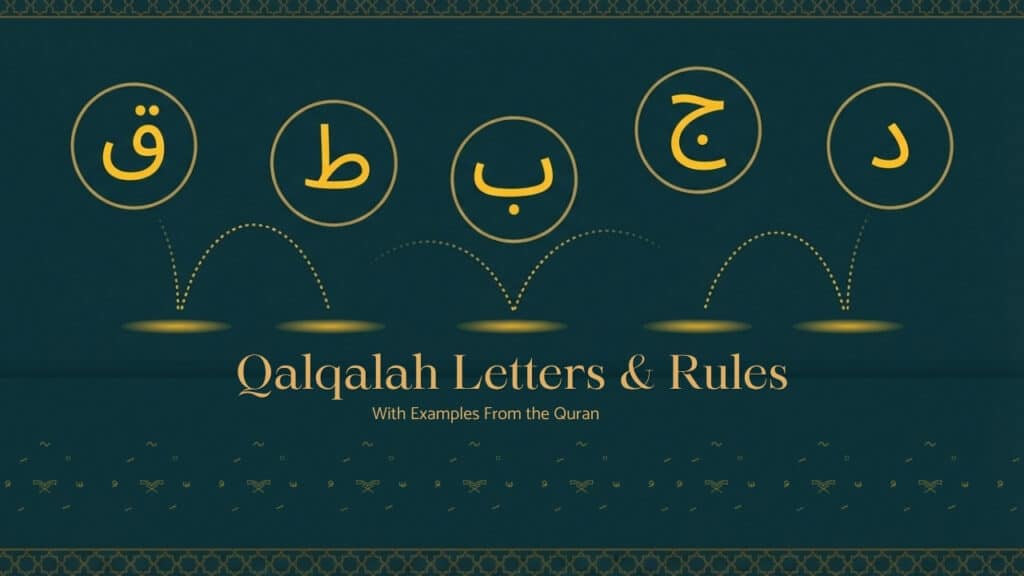
The 5 Qalqalah Letters
The Qalqalah letters are:
- Qāf (ق)
- Ṭāʾ (ط)
- Bāʾ (ب)
- Jīm (ج)
- Dāl (د)
Arab students memorize them with the phrase قُطْبُ جَدٍّ (Qutbu Jadd) — a made-up word containing all five letters. If you’re an English speaker, just remember: Q, T, B, J, D.
Why these five letters specifically? In Tajweed, they share two characteristics: Jahr (the airflow is completely blocked when pronouncing them) and Shiddah (the sound flow is completely blocked too). With both air and sound stopped, the letter needs that small bounce to be released and heard clearly — that’s exactly what Qalqalah provides.
Important: Qalqalah only applies when one of these letters has a sukoon — either written in the text, or created because you stopped (waqf) on the word. A Qalqalah letter with a vowel (fatha, kasra, or damma) is pronounced normally with no bounce.
The 3 Types of Qalqalah Rules
Scholars of Tajweed classify Qalqalah into three levels based on where the letter appears and how you stop on it. The bounce gets stronger as you move from minor to strongest. (Note: you may find slightly different naming across Tajweed books — some scholars call the middle level “Wusta” — but the practical application described below is the same.)
1. Minor Qalqalah (Qalqalah Sughra)
This occurs when a Qalqalah letter has a sukoon in the middle of a word (or in the middle of your recitation flow). The bounce is light and quick — just enough to keep the letter audible.
Example: in يَقْطَعُونَ (yaqṭaʿūn — Surah Al-Baqarah 2:27), the Qāf has a sukoon in the middle of the word, so you give it a small, subtle bounce before moving on. Notice it’s “yaq-ṭaʿūn” with a bounce, not a flat “yak-ṭaʿūn.”
2. Major Qalqalah (Qalqalah Kubra)
This occurs when you stop (waqf) on a Qalqalah letter at the end of a word. Because stopping creates a sukoon — even if the letter originally had a vowel — the bounce becomes clearer and stronger than the minor type.
Example: when you stop at the end of the first verse of Surah Al-Falaq (113:1) on the word الْفَلَقْ (al-falaq), the final Qāf gets a clear, pronounced bounce.
3. Strongest Qalqalah (Qalqalah Akbar)
This is the rarest type: it occurs when you stop on a Qalqalah letter that carries a shaddah (a doubled letter). Since the letter is doubled, the bounce is at its strongest and most emphasized.
Example: stopping on وَتَبَّ (wa-tabb — Surah Al-Masad 111:1). The doubled Bāʾ gets a strong, clear pop of the lips: “wa-tabb.”
Qalqalah Examples from the Quran (Full Table)
Here are examples of all three types for each of the five Qalqalah letters:
| Qalqalah Letter | Minor Qalqalah (Middle of the Word) | Major Qalqalah (Stopping on a Sukoon at the End of the Word) | Strongest Qalqalah (Stopping on a Doubled Letter – Shaddah) |
|---|---|---|---|
| Qāf (ق) | يَقْطَعُونَ – يَقْبَلُ – خَلَقْنَا – أَقْرَبُ – وَقْرًا | الْفَلَقْ – السَّاقْ – خَلَقْ – غَسَقْ – أَغْرَقْ | No well-known Qur’anic example |
| Ṭāʾ (ط) | أَطْعَمَهُمْ – يَطْبَعُ – يَطْمَعُ – قِطْمِيرٍ – يَطْغَى | مُحِيطْ – بَسْطْ – قِسْطْ – سَوْطْ – فَرَّطْ | No well-known Qur’anic example |
| Bāʾ (ب) | أَبْصَارِهِمْ – يُبْصِرُونَ – ابْتَلَى – يَبْخَلُونَ – يَبْعَث | حَطَبْ– كَسَبْ – اقْتَرَبْ – تَبْ – يَكْسِبْ | وَتَبَّ |
| Jīm (ج) | يَجْعَلُونَ – أَجْرًا – نَجْمٌ – يَجْمَعُونَ – أَجْمَعِينَ | خَرَجْ – مَارِجْ – بُرُوجْ – يَلِجْ – أَخْرِجْ | الْحَجُّ |
| Dāl (د) | يَدْعُونَ – أَدْعِيَاءَكُمْ – الْقَدْرِ– يَدْرُسُونَهَا – يَدْخُلُونَ | أَحَدْ – الْمَسَدْ – الصَّمَدْ – لَمْ يَلِدْ – عَادْ | أَشَدُّ – رَدُّوا – يَصُدُّ – يَمُدُّ – يَرْتَدَّ |
Tip: Surah Al-Falaq (113) and Surah Al-Masad (111) are perfect short surahs for practicing Major Qalqalah — almost every verse ends with a Qalqalah letter. Surah Al-Ikhlas (112:1) is another famous example: stopping on أَحَدْ (ahad) gives the Dāl a clear Major Qalqalah.
Common Qalqalah Mistakes to Avoid
Even dedicated students make these mistakes when learning Qalqalah on their own:
- Adding a vowel instead of a bounce. The bounce should not sound like a fatha (“a”), kasra (“i”), or damma (“u”). It’s a neutral echo — “ab,” not “aba.”
- Applying Qalqalah to voweled letters. If the Qalqalah letter has a vowel, there is no bounce at all.
- Making the minor Qalqalah too strong. Inside a word, keep it light and quick — save the emphasis for when you stop at the end.
- Skipping the bounce entirely. Without Qalqalah, the letter gets swallowed and the word can become unclear.
The most reliable way to fix these mistakes is listening and repeating with a qualified teacher who corrects you in real time — self-study with videos alone often locks in errors you can’t hear yourself.
How to Practice Qalqalah as a Non-Arabic Speaker
You don’t need to speak Arabic to master Qalqalah. Try this simple routine:
- Memorize the five letters (Q, T, B, J, D) until you can spot them instantly in the mushaf.
- Listen to a slow, clear reciter (like Sheikh Al-Husary) reciting Surah Al-Falaq and Surah Al-Masad, focusing on the verse endings.
- Repeat out loud and record yourself, then compare your bounce to the reciter’s.
- Recite to a teacher. A trained Quran teacher will catch the subtle mistakes — like adding a hidden vowel — that you can’t hear on your own.
Wondering how long the full Tajweed journey takes? See our guide on how long it takes to learn Tajweed.
At Iqra Wa Rattel Institute, our one-on-one Tajweed classes are designed exactly for this: English-speaking teachers who explain rules like Qalqalah in plain language and correct your recitation live, letter by letter.
FAQs About Qalqalah
What are the 5 Qalqalah letters?
What does Qutbu Jadd mean?
What is the difference between Qalqalah Sughra and Kubra?
What is the strongest type of Qalqalah?
Does Qalqalah apply when the letter has a vowel?
Which surahs are best for practicing Qalqalah?
Can I learn Qalqalah without knowing Arabic?
Learn Qalqalah with a Live Tajweed Teacher
Reading about Qalqalah is a great start — but hearing it and being corrected is how you actually master it. Our certified Tajweed teachers work with students of all ages and levels, entirely in English, one-on-one.
Book your free trial Tajweed class today and hear the difference in your recitation from the very first lesson.