

Have you ever listened to a beautiful Quranic recitation and noticed how the letter Raa (ر) sometimes sounds bold and resonant, while at other times it feels soft and delicate? This captivating variation is not arbitrary—it’s a fundamental aspect of Tajweed, the art and science of Quranic recitation. Mastering the rules of Raa is essential for anyone seeking to recite the Quran correctly and beautifully, whether you’re in London, New York, Birmingham, or Los Angeles.
The letter Raa (ر) is unique in Arabic phonetics because it’s neither permanently heavy nor permanently light. Instead, its pronunciation shifts between two distinct modes: Tafkheem (heavy pronunciation) and Tarqeeq (light pronunciation), depending on specific conditions related to vowel markings and surrounding letters. Understanding and applying these rules correctly can transform your recitation from basic to breathtakingly beautiful, while also preserving the precise meanings intended in the Quran.
In this comprehensive guide, we’ll explore everything you need to know about the rules of Raa in Tajweed, complete with practical examples, common mistakes to avoid, and tips for perfecting your pronunciation. Whether you’re a beginner learning Tajweed for the first time or an advanced student refining your skills, this guide will provide clear, actionable insights to elevate your Quranic recitation.
Understanding the Letter Raa (ر) in Arabic
The Nature of Raa
The letter Raa (ر) is one of the 28 letters in the Arabic alphabet and holds a special position in the science of Tajweed. Unlike most Arabic letters that are either always heavy (like ق, ط, ظ) or always light (like most other letters), Raa is conditional—its heaviness or lightness depends entirely on its context within the word.
Characteristics of Raa
Shape: The letter Raa is written differently depending on its position in a word:
- Isolated: ر
- Initial: رَ
- Middle: ـرـ
- Final: ـر
Sound: Raa is one of the Sun Letters (الحروف الشمسية), which means when preceded by the definite article “ال” (al), it assimilates the “L” sound.
Articulation Point (Makhraj): The Raa is pronounced by vibrating the tip of the tongue against the alveolar ridge—the bony ridge that runs along the upper gums, just behind the upper front teeth. This creates a characteristic rolling or trilling sound.
The Golden Rule for Raa
Here’s a simple rule to remember:
- If Raa has a harakah (vowel) on top (Fatha َ or Dammah ُ), it is typically heavy (Tafkheem).
- If Raa has a harakah underneath (Kasrah ِ), it is typically light (Tarqeeq).
However, as we’ll discover, there are important exceptions and additional rules to consider, especially when Raa has sukoon (no vowel).
What is Tafkheem and Tarqeeq?
Tafkheem (التفخيم) – Heavy Pronunciation
Tafkheem means to make a letter sound “heavy,” “full,” or “thick.” When pronouncing Raa with Tafkheem:
- The back of your tongue rises towards the soft palate (roof of your mouth)
- Your mouth cavity fills with echo
- The sound becomes fuller and deeper
- It’s similar to the ‘r’ sound in the English word “raw” but with more resonance
Example: In the word رَمَضَان (Ramaḍān), the Raa has a Fatha, so it’s pronounced heavily with Tafkheem.
Tarqeeq (الترقيق) – Light Pronunciation
Tarqeeq means to make a letter sound “light,” “thin,” or “delicate.” When pronouncing Raa with Tarqeeq:
- Your tongue stays relatively flat
- The middle part doesn’t rise
- Your mouth position is more like a slight smile
- The sound is softer, similar to the ‘r’ in the English word “read“
Example: In the word شَرِّ (sharr – evil), the Raa has a Kasrah, so it’s pronounced lightly with Tarqeeq.
The Critical Difference
The difference between Tafkheem and Tarqeeq is not just aesthetic—it can actually affect the meaning of words. Proper application of these rules ensures:
- Accurate preservation of Quranic meanings
- Beautiful, melodious recitation
- Following the Sunnah of Prophet Muhammad (peace be upon him)
- Correct articulation as transmitted through generations
Why the Rules of Raa Matter
1. Preserving Quranic Integrity
The Quran has been preserved not just in its written text but also in its oral tradition. The way the Prophet Muhammad (peace be upon him) recited the Quran has been transmitted through an unbroken chain of reciters (Isnād). Applying the rules of Raa correctly ensures you’re reciting as the Prophet did.
2. Maintaining Meaning and Clarity
Incorrect pronunciation of Raa can sometimes alter the intended meaning of words or make the recitation unclear. For example, pronouncing a heavy Raa lightly or vice versa can create confusion about which word is being recited.
3. Achieving Beauty in Recitation
The alternation between heavy and light Raa creates a natural rhythm and melody in Quranic recitation. This variation adds depth and beauty that captivates listeners and enhances the spiritual experience of recitation.
4. Fulfilling Religious Obligation
For Muslims, reciting the Quran with proper Tajweed is considered part of giving the Quran its due right. While minor mistakes may be overlooked, consistently ignoring fundamental rules like those of Raa can affect the validity of recitation, especially in formal prayers.
How to Pronounce the Letter Raa Correctly
Articulation Point (Makhraj al-Raa)
The letter Raa is articulated at the tip of the tongue against the alveolar ridge:
- Position your tongue: Place the tip of your tongue lightly against the area where your upper gums meet your upper front teeth
- Create vibration: Allow air to pass through while your tongue tip vibrates against this ridge
- Control the roll: The vibration should be quick and controlled—a single, crisp tap, not an extended trill
- Adjust for Tafkheem/Tarqeeq: For heavy Raa, raise the back of your tongue; for light Raa, keep it flat
Common Articulation Mistakes
❌ Over-trilling: Pronouncing Raa with excessive vibration (RRRR) is incorrect. The natural characteristic of Raa includes slight vibration (Takreer), but it should be controlled, not exaggerated.
❌ Using the throat: Some learners mistakenly pronounce Raa from the throat, confusing it with غ or خ.
❌ Mimicking English ‘R’: The English ‘r’ is produced with rounded lips and a bunched tongue that doesn’t tap anywhere specific. Arabic Raa is very different.
✅ Correct pronunciation: A single, clean tap of the tongue against the alveolar ridge, with appropriate heaviness or lightness based on Tajweed rules.
Practice Exercise
Try pronouncing these pairs to feel the difference:
- Heavy: رَبّ (Rabb – Lord) vs Light: رِبح (Ribh – profit)
- Heavy: رُوح (Rooh – soul) vs Light: رِيح (Reeh – wind)
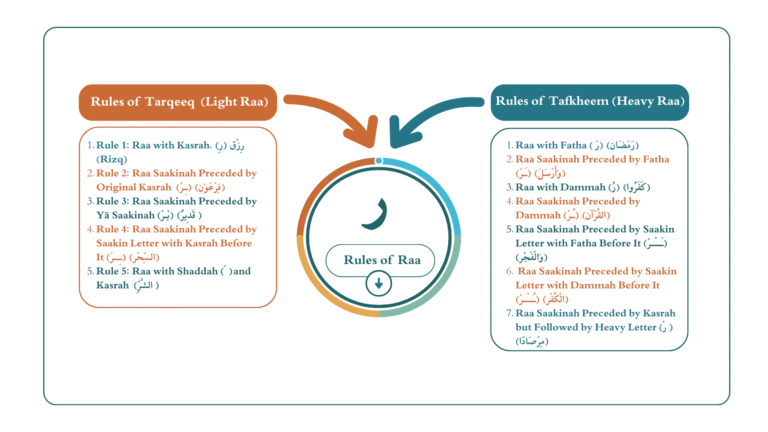
Complete Rules of Tafkheem (Heavy Raa)
The letter Raa must be pronounced with Tafkheem (heavily) in the following nine situations:
Rule 1: Raa with Fatha
Condition: When Raa has a Fatha (َ) on it.
Application: This is the most straightforward rule. Raa with Fatha is always heavy, regardless of position in the word.
Examples:
- رَمَضَان (Ramaḍān) – The blessed month
- أَرْسَلَ (Arsala) – He sent
- النَّار (An-nār) – The fire
Rule 2: Raa with Dammah
Condition: When Raa has a Dammah (ُ) on it.
Application: Raa with Dammah is always heavy.
Examples:
- رُوح (Rūḥ) – Soul/Spirit
- كَفَرُوا (Kafarū) – They disbelieved
- غَفُورٌ رَحِيمٌ (Ghafūrun Raḥīm) – Forgiving and Merciful
Rule 3: Raa Saakinah Preceded by Fatha
Condition: When Raa has sukoon (no vowel) and the letter immediately before it has a Fatha.
Application: The Fatha before Raa Saakinah makes it heavy.
Examples:
- وَأَرْسَلَ (Wa arsala) – “And He sent” (Quran 105:3)
- فِرْعَوْن (Fir’awn) – Wait, this is actually an exception! See Rule under Tarqeeq
- Correct example: مَرْيَم (Maryam) – Mary
Rule 4: Raa Saakinah Preceded by Dammah
Condition: When Raa has sukoon and the letter immediately before it has a Dammah.
Application: The Dammah before Raa Saakinah makes it heavy.
Examples:
- يُرْسِلُ (Yursilu) – He sends
- القُرْآن (Al-Qur’ān) – The Quran
- الغَفُور (Al-Ghafūr) – The Forgiving (when stopping on it)
Rule 5: Raa Saakinah Preceded by Saakin Letter with Fatha Before It
Condition: When Raa has sukoon, and is preceded by a letter that also has sukoon, but the letter before that has a Fatha.
Application: Look two letters back—if there’s a Fatha, Raa is heavy.
Examples:
- وَالْفَجْر (Wal-fajr) – “By the dawn” (Quran 89:1)
- الْعَصْر (Al-‘aṣr) – “By time” (Quran 103:1)
Rule 6: Raa Saakinah Preceded by Saakin Letter with Dammah Before It
Condition: When Raa has sukoon, preceded by a Saakin letter, which is preceded by a Dammah.
Application: The Dammah two letters back makes Raa heavy.
Examples:
- الْكُفْر (Al-kufr) – Disbelief
- يَنْشُر (Yanshu) – To spread (when pausing)
Rule 7: Raa Saakinah Preceded by Temporary Kasrah (Kasrah ‘Āriḍah)
Condition: When Raa has sukoon and is preceded by a temporary Kasrah on Hamzat al-Waṣl (connecting hamza).
Application: Since the Kasrah is temporary (only for connecting words), the Raa remains heavy.
Examples:
- ارْجِعِي (Irji’ī) – “Return” (Quran 89:28)
- رَبِّ ارْجِعُونِ (Rabbi irji’ūn) – “My Lord, send me back” (Quran 23:99)
Why? The Kasrah on the Hamza is not original to the word—it’s added only to connect speech smoothly. The word actually starts with Raa, so the Raa maintains its heavy character.
Rule 8: Raa Saakinah Preceded by Kasrah but Followed by Heavy Letter
Condition: When Raa has sukoon, is preceded by a Kasrah, but is followed by one of the heavy letters (خ ص ض غ ط ق ظ) in the same word.
Application: The heavy letter after Raa influences it to become heavy, overriding the Kasrah before it.
Examples:
- مِرْصَادًا (Mirṣādan) – “An ambush” (Quran 78:21) – followed by ص
- قِرْطَاس (Qirṭās) – “Paper” (Quran 6:7) – followed by ط
- فِرْقَة (Firqah) – “A group” – followed by ق
Note: This is a powerful exception that shows how heavy letters (Isti’lā letters) affect Raa’s pronunciation.
Rule 9: Raa with Shaddah and Fatha or Dammah
Condition: When Raa has a Shaddah (ّ) combined with Fatha or Dammah.
Application: Look only at the vowel on the Shaddah itself.
Examples:
- الرَّحْمٰن (Ar-Raḥmān) – The Most Merciful
- الرَّحِيم (Ar-Raḥīm) – The Most Compassionate
- مَرَرْتُ (Marartu) – I passed by
Complete Rules of Tarqeeq (Light Raa)
The letter Raa must be pronounced with Tarqeeq (lightly) in the following four main situations:
Rule 1: Raa with Kasrah
Condition: When Raa has a Kasrah (ِ) underneath it.
Application: This is absolute and simple. Raa with Kasrah is always light, no exceptions.
Examples:
- رِزْق (Rizq) – Provision
- مِنْ شَرِّ (Min sharri) – “From the evil of” (Quran 113:2)
- القَارِعَة (Al-Qāri’ah) – “The Striking Hour” (Quran 101:1)
Rule 2: Raa Saakinah Preceded by Original Kasrah
Condition: When Raa has sukoon and is preceded by a letter with an original Kasrah (not temporary), and is not followed by a heavy letter in the same word.
Application: The Kasrah before Raa Saakinah makes it light, provided there’s no heavy letter immediately after.
Examples:
- فِرْعَوْن (Fir’awn) – Pharaoh (Quran 2:49)
- شِرْعَة (Shir’ah) – “A law/path” (Quran 5:48)
- لَشِرْذِمَةٌ (La-shirdhimatun) – “A small company” (Quran 26:54)
- فِي مِرْيَةٍ (Fī miryatin) – “In doubt” (Quran 11:110)
Rule 3: Raa Saakinah Preceded by Yā Saakinah
Condition: When you are stopping on a word that ends with Raa, and this Raa is preceded by a Yā with sukoon (يْ).
Application: The Yā before Raa makes it light when pausing.
Examples:
- قَدِيرٌ (Qadīr) – “Competent/Powerful” (when stopping)
- الْخَيْر (Al-khayr) – “The good” (when stopping)
- خَبِيرٌ (Khabīr) – “All-Aware” (when stopping)
- بَصِيرٌ (Baṣīr) – “All-Seeing” (when stopping)
Important Note: This rule applies only when stopping (Waqf) on the word. If continuing the recitation, other rules may apply.
Rule 4: Raa Saakinah Preceded by Saakin Letter with Kasrah Before It
Condition: When Raa has sukoon due to pausing, and is preceded by a Saakin letter (non-heavy Istifāl letter), which is preceded by a Kasrah.
Application: Looking two letters back, if there’s a Kasrah, Raa becomes light.
Examples:
- السِّحْر (As-siḥr) – “The magic” (when stopping)
- الذِّكْر (Adh-dhikr) – “The remembrance” (when stopping)
- الْوِتْر (Al-witr) – “The odd-numbered” (when stopping)
Rule 5: Raa with Shaddah and Kasrah
Condition: When Raa has a Shaddah (ّ) combined with Kasrah underneath.
Application: Look only at the vowel on the Shaddah.
Examples:
- الشَّرِّ (Ash-sharr) – “The evil”
- الضَّرِّ (Aḍ-ḍarr) – “The harm”
Rules for Raa Mushaddad (Raa with Shaddah)
When Raa appears with a Shaddah (ّ), the rule is remarkably simple:
The Simplified Rule
Look only at the vowel (harakah) that appears on the Shaddah itself:
- If the Shaddah has Fatha or Dammah → Heavy (Tafkheem)
- If the Shaddah has Kasrah → Light (Tarqeeq)
Why Is This Important?
The Shaddah represents a doubled letter—essentially two Raas, the first with sukoon and the second with a vowel. However, in practice, we don’t need to analyze it that deeply. Simply follow the vowel on the Shaddah.
Examples of Heavy Raa Mushaddad
- Fatha: الرَّحْمٰن الرَّحِيم (Ar-Raḥmān Ar-Raḥīm) – Both Raas are heavy
- Dammah: يَمُرُّون (Yamurrūn) – “They pass by”
Examples of Light Raa Mushaddad
- Kasrah: مِنْ شَرِّ (Min sharr) – “From the evil of”
- Kasrah: الضَّرِّ (Aḍ-ḍarr) – “The harm”
Special Cases: When Both Tafkheem and Tarqeeq are Permissible
In rare and highly specific situations, Tajweed scholars have allowed both heavy and light pronunciation of Raa. However, even in these cases, one pronunciation is typically preferred over the other.
Case 1: Five Words Where Tarqeeq is Preferred
There are only five words in the entire Quran where both pronunciations are permitted, but Tarqeeq (light) is preferred, especially when continuing the recitation (Waṣl):
فِرْقٍ (Firqin) – “A portion” (Quran 26:63)
- “فَانفَلَقَ فَكَانَ كُلُّ فِرْقٍ كَالطَّوْدِ الْعَظِيمِ”
- “And it parted, and each portion was like a great towering mountain”
فَأَسْرِ (Fa-asri) – “Then set out” (Quran 11:81, 15:65)
يَسْرِ (Yasri) – “It passes” (Quran 89:4)
- “وَاللَّيْلِ إِذَا يَسْرِ”
- “And [by] the night when it passes”
وَنُذُرِ (Wa-nudhuri) – “And My warnings” (appears 6 times in Surah Al-Qamar)
- “فَكَيْفَ كَانَ عَذَابِي وَنُذُرِ”
- “And how [severe] were My punishment and My warnings”
الْقِطْرِ (Al-qiṭr) – “The copper/tar” (Quran 34:12)
- “وَأَسَلْنَا لَهُ عَيْنَ الْقِطْرِ”
- “And We made a spring of liquid copper flow for him”
Why Both Are Allowed: These words contain Raa Saakinah preceded by Kasrah (which calls for Tarqeeq), but in some cases followed by or containing heavy letters (which could justify Tafkheem). Scholars have allowed both, but when continuing recitation, the Kasrah influence is stronger, so Tarqeeq is preferred.
Practical Tip: Accentuating the Kasrah of the Raa lightens its pronunciation naturally.
Case 2: One Word Where Tafkheem is Preferred
There is only one word in the Quran where both are allowed, but Tafkheem (heavy) is preferred, especially when pausing (Waqf):
مِصْرَ (Miṣr) – “Egypt” (Quran 12:99)
- “ادْخُلُوا مِصْرَ إِنْ شَاءَ اللَّهُ آمِنِينَ”
- “Enter Egypt, Allah willing, in safety”
Why Both Are Allowed: When stopping on مِصْر, the Raa is Saakinah, preceded by the heavy letter ص. However, when continuing, the Raa takes a Fatha (مِصْرَ), making it definitely heavy.
Practical Guidance:
- When stopping: Tafkheem is preferred (because of the heavy letter ص)
- When continuing: Tafkheem is definite (because Raa gets Fatha)
Understanding the Flexibility
These exceptional cases demonstrate the profound depth and precision of Tajweed. They show that:
- The science of Tajweed acknowledges contextual complexity
- There is room for legitimate scholarly difference (Ikhtilāf)
- The rules are based on both linguistic structure and historical transmission
Common Mistakes and How to Avoid Them
Even experienced reciters can fall into common errors when pronouncing Raa. Here are the most frequent mistakes and their solutions:
Mistake 1: Over-Trilling the Raa (Takreer)
The Error: Pronouncing Raa with excessive vibration or rolling, creating a prolonged “RRRRRR” sound.
Why It’s Wrong: While Raa naturally has a quality of slight vibration (Takreer is one of its inherent characteristics), exaggerating this quality is considered a mistake (Laḥn). The Prophet (peace be upon him) did not recite this way.
The Fix:
- Practice single, crisp taps of the tongue against the alveolar ridge
- Think of it as a “flick” rather than a “roll”
- Record yourself and listen—if you hear extended vibration, you’re over-trilling
Correct Sound: A quick, controlled vibration—imagine the ‘r’ in Spanish “pero” but even briefer.
Mistake 2: Not Making Heavy Raa Heavy Enough
The Error: Pronouncing words like الرَّحْمٰن (Ar-Raḥmān) with a thin, light Raa sound.
Why It’s Wrong: Many non-native Arabic speakers, especially English speakers, struggle to produce the fullness required for Tafkheem. The recitation sounds flat and lacks the required depth.
The Fix:
- Consciously raise the back of your tongue towards the roof of your mouth
- Create more space in your mouth to allow the sound to echo
- Practice with a teacher who can give you real-time feedback
- Compare your pronunciation with Qaris like Shaykh Mishary Rashid or Shaykh Abdul Basit
Practice Exercise: Say “raw” in English, then exaggerate the depth. That’s the feeling of Tafkheem.
Mistake 3: Confusing Raa with English ‘R’
The Error: Pronouncing Raa like the English letter ‘R’, with rounded lips and no tongue contact with the roof of the mouth.
Why It’s Wrong: The English ‘R’ is completely different phonetically. It’s produced with the tongue bunched in the middle of the mouth and doesn’t involve the tapping characteristic that defines Arabic Raa.
The Fix:
- Unround your lips—Arabic Raa does NOT require lip rounding
- Focus on the tongue tip making contact with the alveolar ridge
- Practice the tapping/flicking motion repeatedly
- Use a mirror to ensure your lips aren’t protruding or rounding
Key Difference: Arabic Raa is a tapped consonant; English ‘R’ is an approximant.
Mistake 4: Using the Throat Instead of the Tongue
The Error: Producing Raa from the throat area, making it sound like غ (Ghayn) or خ (Khā).
Why It’s Wrong: This completely changes the articulation point (Makhraj) of the letter, which is a major error in Tajweed.
The Fix:
- Review the Makhraj (articulation point) with a qualified teacher
- Place your finger at the spot where your upper gums meet your teeth
- Feel the tongue tapping against that exact spot when you say Raa
- Practice minimal pairs: رَبّ (Rabb) vs غَيْب (Ghayb)
Mistake 5: Applying the Wrong Rule
The Error: Making Raa heavy when it should be light, or vice versa.
Examples:
- Saying فِرْعَون (Fir’awn) with a heavy Raa (incorrect)
- Saying رَبّ (Rabb) with a light Raa (incorrect)
Why It’s Wrong: This violates the fundamental rules of Tajweed and can sometimes affect meaning.
The Fix:
- Memorize the rules systematically using this guide
- Practice with a Tajweed teacher who can correct you immediately
- Use color-coded Quran (Tajweed Mushaf) where Raa rules are marked
- Review regularly—consistent practice builds muscle memory
Mistake 6: Not Pausing Properly When Required
The Error: Applying continuous recitation rules when pausing, or pause rules when continuing.
Example: Saying قَدِيرٌ (Qadīr) with heavy Raa when pausing (should be light due to Yā before it).
The Fix:
- Understand that Waqf (stopping) changes rules
- Learn the specific Raa rules that apply only when stopping
- Practice with your teacher, clearly indicating when you’re pausing
Practice Tips and Exercises
Mastering the pronunciation of Raa requires consistent, focused practice. Here are proven strategies to help you improve:
1. Daily Minimal Pair Practice
Practice these word pairs daily to train your ear and tongue to distinguish between heavy and light Raa:
Heavy vs Light:
- رَبّ (Rabb – heavy) vs رِبْح (Ribḥ – light)
- رُوح (Rūḥ – heavy) vs رِيح (Rīḥ – light)
- مَرَّ (Marra – heavy) vs مِرَّة (Mirrah – light)
2. Surah-Based Practice
Focus on short Surahs that contain multiple instances of Raa:
Recommended Surahs:
- Surah Al-Fajr (89): Contains both heavy and light Raas
- Surah Al-‘Asr (103): والْعَصْر (heavy Raa when pausing)
- Surah Al-Qadr (97): لَيْلَةُ الْقَدْرِ (light Raa when pausing)
- Surah An-Nasr (110): النَّصْر (heavy Raa when pausing)
Practice Method:
- Read the Surah slowly, identifying each Raa
- Mark whether each Raa should be heavy or light
- Practice pronouncing each one correctly
- Record yourself and compare with a master reciter
3. Recording and Comparison
Step-by-step:
- Choose a short passage (5-10 verses)
- Record yourself reciting it
- Listen to the same passage by a qualified Qari (like Mishary Rashid, Abdul Basit, or Husary)
- Compare your recording with theirs, focusing specifically on Raa sounds
- Note differences and practice corrections
- Re-record and compare again
4. Work with a Tajweed Teacher
Nothing replaces live feedback from a qualified teacher:
Benefits:
- Real-time correction of pronunciation errors
- Personalized guidance based on your specific challenges
- Verification that you’re applying rules correctly
- Motivation and structured progression
Finding a Teacher:
- Local mosques often offer Tajweed classes
- Online platforms (like Baytul Quran, Quranica, Riwaq Al Quran) connect you with certified teachers
- One-on-one sessions provide the most benefit
5. Use Visual Aids
Color-Coded Mushaf (Tajweed Quran):
- Heavy letters (including heavy Raas) are often marked in one color
- Light letters (including light Raas) in another
- This visual reference helps you apply rules correctly while reading
Tajweed Apps:
- Apps like “Tajweed Quran” highlight rules in real-time
- Interactive exercises test your knowledge
- Audio pronunciation guides for each rule
6. Understand, Don’t Just Memorize
Why This Matters:
- Rote memorization of examples doesn’t help with new words
- Understanding the underlying principles allows you to apply rules to any word
- This guide provides those principles—review them regularly
Practical Application:
- When you encounter a new word with Raa, pause
- Identify: Does Raa have a vowel? What is it?
- If Sukoon, what’s before it? What’s after it?
- Apply the appropriate rule consciously
- With practice, this becomes automatic
7. Slow, Deliberate Recitation (Tartīl)
The Quran encourages us to recite with Tartīl (slow, measured recitation):
“…and recite the Quran with measured recitation.” (Quran 73:4)
Benefits for Learning Raa:
- Gives you time to think about each Raa
- Allows precise articulation
- Prevents rushing, which causes mistakes
- Builds correct muscle memory
Practice: Recite one page daily at half your normal speed, focusing entirely on Raa pronunciation.
8. Monthly Review Sessions
Schedule:
- Set aside 1-2 hours each month
- Review all the rules in this guide
- Test yourself with new passages
- Identify areas where you still struggle
- Focus your next month’s practice on those areas
Additional Resources for Learning
Recommended Online Courses
- Baytul Quran – Comprehensive Tajweed courses with certified teachers
- Quranica – Offers Beginner and Advanced Tajweed programs with live classes
- Riwaq Al Quran – Specializes in Arabic and Quranic studies with native tutors
Recommended Books
- “Tajweed Rules of the Quran” by Kareema Carol Czerepinski
- “The Art of Reciting the Quran” by Kristina Nelson
- “Provisions for the Seekers” (Tuhfat al-Atfal) – Classical Tajweed poem
YouTube Channels for Raa Practice
- Tarteel – Detailed Tajweed lessons in English
- Learn Tajweed – Visual demonstrations of Raa rules
- Islamic Lessons Made Easy – “Mastering the Letter Raa in Quranic Recitation”
Conclusion: The Journey to Mastery
Mastering the rules of Raa in Tajweed is a beautiful and deeply rewarding aspect of your relationship with the Quran. Each correctly pronounced Raa brings your recitation closer to the way the Prophet Muhammad (peace be upon him) recited, preserving a tradition that has been passed down through fourteen centuries.
Key Takeaways
Remember the Core Principles:
- Raa is conditional—neither always heavy nor always light
- Tafkheem (heavy) occurs with Fatha/Dammah or when influenced by heavy letters
- Tarqeeq (light) occurs with Kasrah or when preceded by Kasrah/Yā
- There are rare exceptions where both are permissible
- Proper pronunciation affects meaning, beauty, and religious validity
Your Path Forward:
- Study these rules thoroughly—understanding beats memorization
- Practice daily with focused exercises
- Seek feedback from qualified teachers
- Listen to master reciters regularly
- Be patient with yourself—mastery takes time
- Apply what you learn in your daily Quran recitation
- Review regularly to maintain and refine your skills
The Spiritual Dimension
Beyond the technical aspects, remember that learning Tajweed is an act of worship. When you strive to perfect your pronunciation of Raa, you are:
- Honoring the Quran by reciting it as it was revealed
- Following the Sunnah of the Prophet (peace be upon him)
- Drawing closer to Allah through His Book
- Preserving Islamic heritage for future generations
- Beautifying your prayers and personal connection with the Quran
The Prophet Muhammad (peace be upon him) said:
“The one who is proficient in the recitation of the Quran will be with the honorable and obedient scribes (angels), and he who recites the Quran and finds it difficult to recite, doing his best to recite it in the best way possible, will have two rewards.” (Sahih Al-Bukhari & Muslim)
Whether you find Raa pronunciation easy or challenging, every sincere effort is rewarded by Allah. Don’t be discouraged by initial difficulties—even the Companions of the Prophet (may Allah be pleased with them) had to learn and practice.
Next Steps
Now that you’ve completed this comprehensive guide:
- Review the rules one more time, making notes
- Identify 2-3 specific areas where you struggle most
- Create a practice schedule (even 10 minutes daily makes a difference)
- Find a qualified teacher or online course for feedback
- Apply these rules in your daily Quran reading immediately
- Share this knowledge with family and friends learning Tajweed
- Make dua asking Allah to help you perfect your Quranic recitation
Final Encouragement
The journey to mastering the rules of Raa—and Tajweed in general—is not about perfection from day one. It’s about consistent effort, sincere intention, and gradual improvement. Each day you practice, you become better. Each mistake you correct brings you closer to excellence.
May Allah accept your efforts, beautify your recitation, and make the Quran a source of light, guidance, and intercession for you in this life and the Hereafter. May He allow us all to recite His Book in the manner that pleases Him most.
Ameen.