
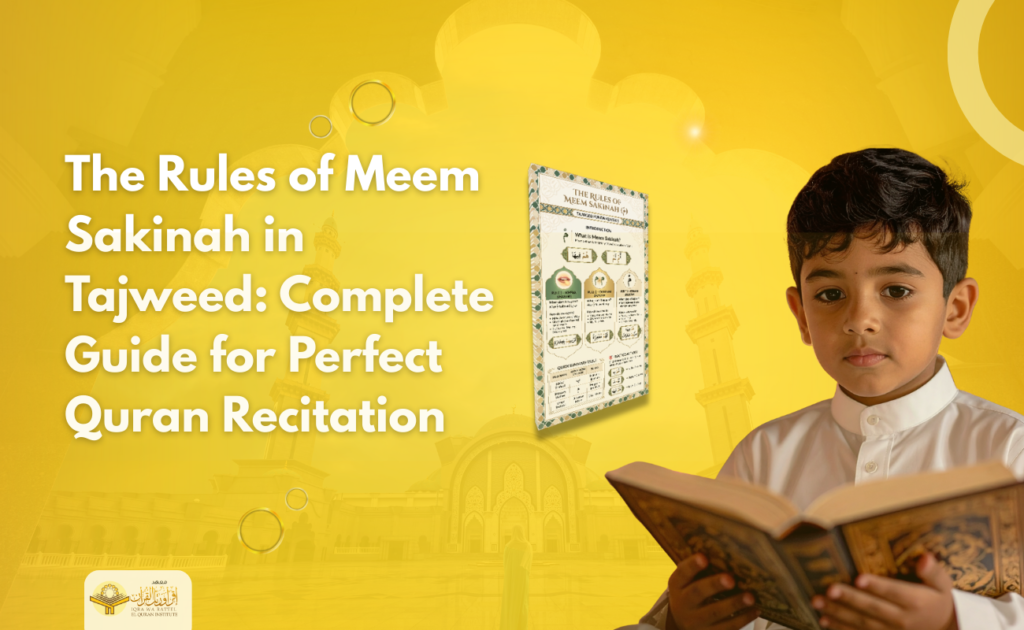
Introduction: Understanding the Importance of Meem Sakinah Rules
The art of reciting the Holy Quran with proper Tajweed is a fundamental aspect of Islamic practice that connects believers directly to the divine revelation. Among the various Tajweed principles, the rules of meem sakinah stand as essential guidelines that every Muslim seeking to recite the Quran accurately must master.
The Prophet Muhammad (peace be upon him) emphasized the importance of reciting the Quran correctly when he said: “The one who is proficient in the recitation of the Quran will be with the honourable and obedient scribes (angels).” This hadith highlights the spiritual significance of mastering Tajweed rules, including the specific guidelines governing Meem Sakinah pronunciation.
This comprehensive guide will provide you with an in-depth understanding of the rules of meem sakinah, their applications in Quranic recitation, and practical methods to implement them correctly. Whether you are a beginner embarking on your Tajweed journey or an experienced reciter seeking to refine your skills, this article will serve as your complete resource.
What is Meem Sakinah? Defining the Fundamental Concept
Before exploring the specific rules, it is essential to establish a clear understanding of what Meem Sakinah represents in the context of Tajweed and Quranic recitation.
Understanding Saakin in Arabic Pronunciation
The term “Saakin” in Arabic grammar and Tajweed refers to a letter that carries no vowel sound. In written Arabic, this is indicated by the Sukoon symbol, which appears as a small circle above the letter. A Saakin letter is essentially a consonant that is pronounced without the accompanying short vowels (Fatha, Damma, or Kasra).
This concept of silence or pause in pronunciation is fundamental to understanding how various Tajweed rules operate, as many rules specifically address how to handle these non-voweled letters in different contexts.
Meem Sakinah: The Silent Meem
Meem Sakinah is the letter Meem (م) when it appears with a Sukoon mark (ْ) above it, rendering it silent or non-voweled. This creates a static consonant sound that requires specific pronunciation treatment depending on the letter that immediately follows it.
The Meem Sakinah can appear in two positions within Arabic text:
- At the end of a word
- In the middle of a word
In both cases, the same pronunciation rules apply based on the subsequent letter. Understanding these positional occurrences helps reciters identify when to apply the rules of meem sakinah during their recitation.
Why Meem Sakinah Rules Matter
The rules of meem sakinah exist to ensure:
1. Phonetic Beauty: These rules create smooth transitions between sounds, making recitation more melodious and pleasant to hear.
2. Linguistic Accuracy: They preserve the authentic pronunciation methods transmitted through centuries of Islamic scholarship.
3. Meaning Preservation: Proper pronunciation prevents potential misunderstandings or alterations in the Quranic message.
4. Spiritual Connection: Reciting correctly demonstrates respect for Allah’s words and deepens the reciter’s spiritual engagement with the Quran.
5. Following the Sunnah: The Prophet (peace be upon him) recited the Quran with these rules, and following them means adhering to his example.
The Three Essential Rules of Meem Sakinah
The pronunciation of Meem Sakinah is governed by three distinct rules, each determined by the specific letter that follows the silent Meem. These rules are known as Ikhfa Shafawi, Idgham Shafawi, and Izhar Shafawi. Understanding when and how to apply each rule is the cornerstone of proper Tajweed practice.
Unlike the four rules that govern Noon Sakinah and Tanween, Meem Sakinah has only three rules, making it somewhat simpler to master. However, the precision required in applying these rules demands careful study and consistent practice.
Rule 1: Ikhfa Shafawi (الإخفاء الشفوي) – Labial Concealment
Definition and Meaning
Ikhfa Shafawi, which translates to “Labial Concealment,” is the first rule of meem sakinah. The term “Ikhfa” means to conceal or hide, while “Shafawi” refers to the lips (from the Arabic word “Shafah” meaning lip). This rule requires the reciter to partially conceal the sound of Meem Sakinah while producing a nasal sound known as Ghunnah.
When Does Ikhfa Shafawi Occur?
This rule applies in only one specific scenario: when a Meem Sakinah (مْ) is followed by the letter Baa (ب).
The letter that triggers Ikhfa Shafawi: ب (Baa)
This is the simplest rule to remember among the rules of meem sakinah because it involves only a single letter. Whenever you encounter a Meem Sakinah followed by Baa, you must apply Ikhfa Shafawi without exception.
How to Pronounce Ikhfa Shafawi Correctly
The correct pronunciation of Ikhfa Shafawi involves a specific technique that combines partial concealment with nasal resonance:
Step 1: Lip Position
- Bring your lips close together but do not press them firmly
- Maintain a very slight gap between the lips
- The lips should touch gently, preparing for the upcoming Baa sound
Step 2: Nasal Sound (Ghunnah)
- Produce a clear nasal sound (Ghunnah) from your nasal cavity
- Hold this Ghunnah for approximately one count (Haraka)
- The sound should resonate distinctly in the nose
Step 3: Concealment
- The original clear sound of Meem is softened and partially hidden
- The Meem sound blends subtly into the Ghunnah
- Transition smoothly from the concealed Meem into the Baa sound
Step 4: Timing
- The duration of the Ghunnah should be approximately one beat
- Do not hold it too long or release it too quickly
- Maintain consistent timing across your recitation
The Articulation Point
Both Meem and Baa are articulated from the same point: the lips. This shared articulation point is precisely why concealment occurs naturally. When these two labial letters meet, the mouth position for the Meem smoothly transitions into the position needed for Baa, creating a fluid pronunciation that requires partial hiding of the Meem sound.
Examples from the Quran
Understanding Ikhfa Shafawi becomes clearer through practical examples from the Quranic text:
Example 1: Surah Al-Fil (105:4)
تَرْمِيهِم بِحِجَارَةٍ (Tarmihim bihijaratin) “Striking them with stones”
In this verse, the word “تَرْمِيهِمْ” (Tarmihim) ends with Meem Sakinah, which is immediately followed by “بِحِجَارَةٍ” (bihijaratin) beginning with the letter Baa. This requires the application of Ikhfa Shafawi. The reciter should gently conceal the Meem with a light Ghunnah before transitioning into the Baa sound.
Example 2: Surah At-Takwir (81:22)
وَمَا صَاحِبُكُم بِمَجْنُونٍ (Wa ma sahibukum bimajnun) “And your companion is not mad”
Here, the word “صَاحِبُكُمْ” (sahibukum) concludes with Meem Sakinah, followed by “بِمَجْنُونٍ” (bimajnun) starting with Baa. Apply Ikhfa Shafawi by concealing the Meem sound with gentle nasal resonance.
Example 3: Surah Al-Baqarah (2:8)
وَمَا هُم بِمُؤْمِنِينَ (Wa ma hum bimu’minin) “But they are not believers”
The word “هُمْ” (hum) ends with Meem Sakinah and is followed by “بِمُؤْمِنِينَ” (bimu’minin) beginning with Baa. This is another clear instance requiring Ikhfa Shafawi application.
Example 4: Surah Ghafir (40:16)
يَوْمَ هُم بَارِزُونَ (Yawma hum barizun) “The Day they will emerge”
In this verse, “هُمْ” (hum) with Meem Sakinah precedes “بَارِزُونَ” (barizun) starting with Baa, necessitating the concealment rule.
Common Mistakes in Ikhfa Shafawi
Mistake 1: Closing Lips Too Tightly Many learners close their lips completely, making the sound resemble Iqlab from Noon Sakinah rules. The lips should remain slightly separated.
Correction: Practice maintaining a gentle gap between lips while producing the nasal sound.
Mistake 2: Omitting the Ghunnah Some reciters forget to produce the nasal sound, pronouncing the Meem clearly instead.
Correction: Always remember that Ghunnah is mandatory in Ikhfa Shafawi. Practice feeling the vibration in your nasal cavity.
Mistake 3: Excessive Ghunnah Duration Holding the Ghunnah for too long (more than one count) distorts the recitation flow.
Correction: Time your Ghunnah to approximately one beat, similar to the duration of one short vowel.
Mistake 4: Pronouncing Meem Clearly Instead of concealing the Meem, some learners articulate it distinctly before the Baa.
Correction: Remember that “Ikhfa” means concealment. The Meem sound should be softened and partially hidden within the Ghunnah.
Rule 2: Idgham Shafawi (الإدغام الشفوي) – Labial Merging
Definition and Meaning
Idgham Shafawi, which translates to “Labial Merging,” is the second rule governing the pronunciation of meem sakinah. The term “Idgham” means to merge or assimilate, and in this context, it refers to the complete merging of one Meem sound into another. This rule is also known as “Idgham Mithlain Sagheer,” which means the merging of two identical (Mithla) letters where the first is Saakin and the second has a vowel.
When Does Idgham Shafawi Occur?
Idgham Shafawi applies when a Meem Sakinah (مْ) is followed by another Meem (م) that carries a vowel (Fatha, Damma, or Kasra).
The letter that triggers Idgham Shafawi: م (Meem with vowel)
This rule is relatively easy to identify because it involves two identical letters appearing consecutively, with the first being silent and the second being voweled.
How to Pronounce Idgham Shafawi Correctly
The proper execution of Idgham Shafawi requires complete merging with emphasis:
Step 1: Complete Merging
- Do not pronounce the first Meem Sakinah separately
- Merge both Meem sounds completely into one
- The two letters blend seamlessly as if only one Meem exists
Step 2: Emphasis (Shaddah Effect)
- The resulting merged Meem is pronounced with stress
- This creates an effect similar to a Meem with Shaddah (مّ)
- The sound is strengthened and emphasized
Step 3: Ghunnah Duration
- Produce a clear, full Ghunnah (nasal sound)
- Hold the Ghunnah for two counts (two Harakas)
- This is longer than the Ghunnah in Ikhfa Shafawi
Step 4: Lip Closure
- Close your lips completely and firmly
- This full closure distinguishes it from Ikhfa Shafawi
- The sound resonates through the nose while lips remain closed
The Concept of Mithlain (Identical Letters)
The term “Mithlain” refers to two identical letters appearing in sequence. In Arabic phonetics, when two identical letters meet with the first being Saakin and the second carrying a vowel, they naturally merge to create a more fluid pronunciation. This linguistic phenomenon is observed in various Arabic words and is a fundamental principle in Tajweed.
The merging happens because:
- Both letters share the same articulation point (the lips)
- Both letters have identical sound characteristics
- Pronouncing them separately would create an awkward, unnatural break in flow
Examples from the Quran
Example 1: Surah Al-Buruj (85:11)
لَهُم مَّا يَشَاءُونَ (Lahum ma yasha’un) “For them is whatever they wish”
The word “لَهُمْ” (Lahum) ends with Meem Sakinah, which is followed by “مَّا” (ma) beginning with a voweled Meem. These two Meems merge completely with a two-count Ghunnah, creating the sound “Lahum-ma” where the double Meem is emphasized.
Example 2: Surah Al-Humazah (104:8)
إِنَّهَا عَلَيْهِم مُّؤْصَدَةٌ (Innaha ‘alayhim mu’sadah) “Indeed, Hellfire will be closed upon them”
Here, “عَلَيْهِمْ” (‘alayhim) with final Meem Sakinah is followed by “مُّؤْصَدَةٌ” (mu’sadah) starting with voweled Meem. The complete merging with Ghunnah is required.
Example 3: Surah Quraysh (106:4)
الَّذِي أَطْعَمَهُم مِّن جُوعٍ (Alladhi at’amahum min ju’) “Who has fed them, sparing them from hunger”
The word “أَطْعَمَهُمْ” (at’amahum) ends with Meem Sakinah and is followed by “مِّنْ” (min) beginning with voweled Meem. Apply complete Idgham with two-count Ghunnah.
Example 4: Surah Az-Zumar (39:34)
لَهُم مَّا يَشَاءُونَ (Lahum ma yasha’un) “For them is whatever they wish”
This verse demonstrates the same pattern where “لَهُمْ” (Lahum) merges with the following “مَّا” (ma), creating the emphasized, merged Meem sound.
Example 5: Surah At-Tawbah (9:118)
عَلَيْهِمْ مِن رَبِّهِمْ (‘Alayhim min rabbihim) “Upon them from their Lord”
The Meem Sakinah at the end of “عَلَيْهِمْ” (‘alayhim) merges with the Meem beginning “مِنْ” (min).
Distinguishing Idgham Shafawi from Ikhfa Shafawi
Understanding the difference between these two rules is crucial:
Idgham Shafawi (Merging):
- Occurs with Meem followed by Meem
- Complete merging of sounds
- Lips close fully
- Ghunnah duration: TWO counts
- Creates an emphasized, stressed sound
Ikhfa Shafawi (Concealment):
- Occurs with Meem followed by Baa
- Partial concealment of sound
- Lips touch gently with slight gap
- Ghunnah duration: ONE count
- Creates a softer, concealed sound
Common Mistakes in Idgham Shafawi
Mistake 1: Pronouncing First Meem Separately Some learners pronounce the Meem Sakinah distinctly before merging into the second Meem.
Correction: The merging should be immediate and complete from the start. Think of it as one extended Meem sound, not two separate ones.
Mistake 2: Insufficient Ghunnah Duration Holding the Ghunnah for less than two counts makes the recitation rushed.
Correction: Practice counting “one-two” slowly while maintaining the nasal sound. The Ghunnah should be held for the full two-beat duration.
Mistake 3: Weak Emphasis Not stressing the merged Meem sufficiently results in a weak sound.
Correction: The merged Meem should sound strong and emphasized, as if it carries a Shaddah mark. Practice pronouncing it with clear stress.
Mistake 4: Incomplete Lip Closure Leaving lips partially open during Idgham weakens the sound quality.
Correction: Ensure complete lip closure, similar to pronouncing a regular Meem sound. Feel the lips press together firmly.
Rule 3: Izhar Shafawi (الإظهار الشفوي) – Labial Clarity
Definition and Meaning
Izhar Shafawi, meaning “Labial Clarity,” is the third and most frequently occurring rule among the rules of meem sakinah. The term “Izhar” means to make clear or to pronounce distinctly. This rule requires the reciter to articulate the Meem Sakinah clearly and completely, without any concealment, merging, or nasal modification.
When Does Izhar Shafawi Occur?
Izhar Shafawi applies when a Meem Sakinah (مْ) is followed by any letter of the Arabic alphabet except for Baa (ب) and Meem (م).
The letters that trigger Izhar Shafawi: All 26 remaining Arabic letters
These 26 letters are: ء – ت – ث – ج – ح – خ – د – ذ – ر – ز – س – ش – ص – ض – ط – ظ – ع – غ – ف – ق – ك – ل – ن – هـ – و – ي
Since this rule covers 26 out of 28 letters, Izhar Shafawi is the most common situation you will encounter when reciting the Quran.
How to Pronounce Izhar Shafawi Correctly
The pronunciation of Izhar Shafawi is straightforward but requires attention to detail:
Step 1: Clear Pronunciation
- Articulate the Meem Sakinah sound completely and distinctly
- Do not soften, conceal, or merge the sound
- Pronounce it from the lips with full clarity
Step 2: No Ghunnah
- Do not produce any nasal sound (Ghunnah)
- The sound should come purely from the lip articulation
- There should be no nasal resonance
Step 3: Complete Separation
- Maintain clear separation between the Meem sound and the following letter
- Each letter should be pronounced independently
- Do not blend or merge the sounds together
Step 4: Proper Lip Movement
- Close lips completely for the Meem sound
- Open lips cleanly to transition to the next letter
- Ensure the movement is deliberate and precise
Special Attention Required: Waw and Faa
While Izhar Shafawi applies to all 26 letters equally, Islamic scholars emphasize the need for extra caution when the Meem Sakinah is followed by two specific letters:
1. Waw (و) Because Waw shares some lip-related characteristics with Meem (both involve lip rounding), there is a natural tendency to soften or partially merge the sounds. Reciters must consciously pronounce the Meem clearly and distinctly before moving to the Waw sound.
2. Faa (ف) Similarly, Faa is articulated very close to the lips (specifically, the lower lip touching the upper teeth), which creates a proximity that might tempt reciters to soften the Meem. The Meem must remain completely clear and separate from the Faa.
When encountering these two letters, experienced teachers recommend slightly emphasizing the Meem to ensure it does not accidentally turn into a concealed sound resembling Ikhfa Shafawi.
Examples from the Quran
Example 1: Surah Al-Fatihah (1:7)
صِرَاطَ الَّذِينَ أَنْعَمْتَ عَلَيْهِمْ (Sirat alladhina an’amta ‘alayhim) “The path of those upon whom You have bestowed favor”
The word “عَلَيْهِمْ” (‘alayhim) ends with Meem Sakinah, and since it appears at the end of the verse (followed by a pause), it is pronounced with complete clarity using Izhar Shafawi.
Example 2: Surah Al-Kafirun (109:6)
لَكُمْ دِينُكُمْ وَلِيَ دِينِ (Lakum dinukum waliya din) “For you is your religion, and for me is my religion”
The word “لَكُمْ” (Lakum) has Meem Sakinah followed by “دِينُكُمْ” (dinukum) beginning with the letter Daal (د). Since Daal is one of the 26 letters requiring Izhar, the Meem must be pronounced clearly.
Example 3: Surah Al-Jumu’ah (62:9)
ذَٰلِكُمْ خَيْرٌ لَّكُمْ (Dhalikum khayrun lakum) “That is best for you”
In “ذَٰلِكُمْ” (Dhalikum), the Meem Sakinah is followed by “خَيْرٌ” (khayrun) starting with Kha (خ). Apply Izhar Shafawi by pronouncing the Meem distinctly.
Example 4: Surah Al-Baqarah (2:6)
سَوَاءٌ عَلَيْهِمْ أَأَنذَرْتَهُمْ (Sawa’un ‘alayhim a-andhartahum) “It is all the same for them whether you warn them”
The Meem Sakinah in “عَلَيْهِمْ” (‘alayhim) is followed by a Hamza (ء) in “أَأَنذَرْتَهُمْ” (a-andhartahum). Clear pronunciation is required.
Example 5: Surah Ali ‘Imran (3:110)
كُنتُمْ خَيْرَ أُمَّةٍ (Kuntum khayra ummatin) “You are the best nation”
The word “كُنتُمْ” (Kuntum) ends with Meem Sakinah followed by “خَيْرَ” (khayra) beginning with Kha. This requires clear Izhar pronunciation.
Example 6: Surah An-Nas (114:1)
قُلْ أَعُوذُ بِرَبِّ النَّاسِ (Qul a’udhu bi-rabbi an-nas) “Say: I seek refuge in the Lord of mankind”
Although not immediately apparent, when “النَّاسِ” (an-nas) is followed by the next verse or in continuous recitation, the Meem Sakinah would be pronounced with Izhar if followed by appropriate letters.
Example 7: Surah Al-Ma’un (107:1)
أَرَأَيْتَ الَّذِي يُكَذِّبُ بِالدِّينِ (Ara’ayta alladhi yukadhdhibu bid-din)
When connecting verses in continuous recitation, attention must be paid to any Meem Sakinah and the following letter to determine proper pronunciation.
Why Is Izhar Shafawi Most Common?
Since Izhar Shafawi applies to 26 out of 28 Arabic letters, it naturally becomes the most frequently encountered rule among the rules of meem sakinah. This statistical reality means that:
- Most instances of Meem Sakinah in the Quran require clear pronunciation
- Reciters should develop a strong default habit of clear Meem articulation
- Special attention is only needed for the two exceptional cases (Baa and Meem)
Common Mistakes in Izhar Shafawi
Mistake 1: Adding Unnecessary Ghunnah Some learners habitually add a nasal sound to every Meem Sakinah.
Correction: Remember that Ghunnah is ONLY required in Ikhfa Shafawi and Idgham Shafawi. Izhar Shafawi must be completely free of nasal sound.
Mistake 2: Merging with Following Letters Reciters sometimes blend the Meem sound into the next letter, especially with Waw and Faa.
Correction: Maintain distinct separation. Each letter should be independently audible with clear boundaries between sounds.
Mistake 3: Weak or Unclear Meem Pronunciation Some learners pronounce the Meem too softly or incompletely.
Correction: The Meem should be pronounced with full strength and clarity. Practice saying the Meem with deliberate lip closure and opening.
Mistake 4: Confusion with Ikhfa When Meem Sakinah is followed by Waw or Faa, some reciters mistakenly treat it as Ikhfa.
Correction: Only Baa triggers Ikhfa Shafawi. All other letters, including Waw and Faa, require clear Izhar pronunciation.
Mistake 5: Rushing Through the Meem In fast recitation, the Meem might be glossed over too quickly.
Correction: Even in fluent recitation, ensure each Meem Sakinah receives its full articulation time and clarity.
Comparative Summary: The Three Rules of Meem Sakinah
To consolidate your understanding, here is a comprehensive comparison of all three rules:
Rule Comparison Chart
Rule Name: Ikhfa Shafawi (Labial Concealment) Meaning: To conceal or hide Occurs When: Meem Sakinah + Baa (ب) Number of Letters: 1 letter only Pronunciation Method: Partial concealment with gentle lip contact Ghunnah Required: Yes – ONE count Lip Position: Gentle touch with slight gap Sound Characteristic: Soft, concealed, flowing Frequency: Least common
Rule Name: Idgham Shafawi (Labial Merging) Meaning: To merge or assimilate Occurs When: Meem Sakinah + Meem (م) Number of Letters: 1 letter only Pronunciation Method: Complete merging with emphasis Ghunnah Required: Yes – TWO counts Lip Position: Complete, firm closure Sound Characteristic: Strong, stressed, emphasized Frequency: Less common
Rule Name: Izhar Shafawi (Labial Clarity) Meaning: To make clear Occurs When: Meem Sakinah + Any other letter (26 letters) Number of Letters: 26 letters Pronunciation Method: Clear, distinct articulation Ghunnah Required: No Lip Position: Full closure then clean opening Sound Characteristic: Clear, separated, distinct Frequency: Most common
Key Distinction Points
Between Ikhfa and Idgham:
- Ikhfa conceals (partial), Idgham merges (complete)
- Ikhfa has Ghunnah, Idgham has two-count Ghunnah
- Ikhfa keeps lips slightly apart, Idgham closes lips fully
- Ikhfa with Baa, Idgham with Meem
Between Ikhfa and Izhar:
- Ikhfa conceals with Ghunnah, Izhar pronounces clearly without Ghunnah
- Ikhfa only with Baa, Izhar with 26 other letters
- Ikhfa has nasal resonance, Izhar has no nasalization
Between Idgham and Izhar:
- Idgham merges two sounds into one, Izhar keeps them separate
- Idgham requires Ghunnah, Izhar requires no Ghunnah
- Idgham creates emphasis, Izhar maintains natural pronunciation
Understanding Ghunnah in the Rules of Meem Sakinah
Since Ghunnah plays a crucial role in two of the three rules, it is essential to understand this concept thoroughly.
What is Ghunnah?
Ghunnah is a nasal sound produced when air flows through the nasal cavity during pronunciation. It is a melodious, humming sound that adds beauty and rhythm to Quranic recitation. The word “Ghunnah” itself means “nasalization” in Arabic.
Characteristics of Proper Ghunnah
1. Source Location
- The sound originates from the nasal cavity, not the throat or mouth
- You should feel vibration in your nose during proper Ghunnah
- Place a finger gently on your nose to feel the resonance
2. Duration Requirements
- Ghunnah duration is measured in “counts” or “Harakas”
- One count equals approximately the time to say one short vowel
- Ikhfa Shafawi requires ONE count of Ghunnah
- Idgham Shafawi requires TWO counts of Ghunnah
3. Sound Quality
- The Ghunnah should be smooth and continuous
- It should not be harsh, forced, or excessively loud
- The tone should blend naturally with the surrounding recitation
4. Timing Consistency
- Maintain consistent Ghunnah duration throughout your recitation
- Do not shorten it when reciting quickly
- Do not extend it beyond the required counts
Where Ghunnah Applies in Meem Sakinah Rules
With Ghunnah:
- Ikhfa Shafawi (when followed by Baa) – ONE count
- Idgham Shafawi (when followed by Meem) – TWO counts
Without Ghunnah:
- Izhar Shafawi (when followed by 26 other letters) – NO Ghunnah
How to Practice Ghunnah
Exercise 1: Isolated Ghunnah Practice
- Close your mouth and hum for two seconds
- Feel the vibration in your nasal cavity
- This is the base sensation of proper Ghunnah
Exercise 2: Timed Ghunnah
- Use a metronome or timer
- Practice holding Ghunnah for exactly one beat, then two beats
- Develop consistent timing through repetition
Exercise 3: Ghunnah with Letter Practice
- Practice “مْب” (Meem Sakinah + Baa) with one-count Ghunnah
- Practice “مْم” (Meem Sakinah + Meem) with two-count Ghunnah
- Record yourself and compare with expert reciters
Meem Mushaddadah and Noon Mushaddadah: Related Rules
While focusing on the rules of meem sakinah, it is beneficial to understand related rules that involve Meem and Noon with Shaddah.
What is Shaddah?
Shaddah (ّ) is a diacritical mark in Arabic that indicates the doubling or stressing of a consonant. When a letter carries Shaddah, it is pronounced with emphasis, as if the letter appears twice.
The Rule of Meem Mushaddadah (مّ)
When the letter Meem carries a Shaddah mark (مّ), creating what is known as Meem Mushaddadah, a specific Tajweed rule applies.
Pronunciation Requirement:
- Pronounce the doubled Meem with full Ghunnah
- Hold the Ghunnah for TWO complete counts
- The sound should be emphasized and strong
- Complete lip closure is required
Example from the Quran:
Surah Al-Qari’ah (101:6): فَأَمَّا مَن ثَقُلَتْ مَوَازِينُهُ (Fa-amma man thaqulat mawazinuhu) “Then as for one whose scales are heavy”
The word “أَمَّا” (amma) contains Meem Mushaddadah, requiring a two-count Ghunnah with emphasis.
The Rule of Noon Mushaddadah (نّ)
Similarly, when the letter Noon carries a Shaddah mark (نّ), creating Noon Mushaddadah, the same principle applies.
Pronunciation Requirement:
- Pronounce the doubled Noon with full Ghunnah
- Hold the Ghunnah for TWO complete counts
- The sound resonates through the nasal cavity
- This is an obligatory (Wajib) requirement
Example from the Quran:
Surah An-Nas (114:6): مِنَ الْجِنَّةِ وَالنَّاسِ (Mina al-jinnati wan-nas) “From among the jinn and mankind”
Both “الْجِنَّةِ” (al-jinnati) and “النَّاسِ” (an-nas) contain Noon Mushaddadah, each requiring full two-count Ghunnah.
Similarity with Meem Sakinah Rules
Notice the connection:
- Idgham Shafawi (Meem Sakinah + Meem) = TWO counts Ghunnah
- Meem Mushaddadah = TWO counts Ghunnah
- Noon Mushaddadah = TWO counts Ghunnah
All these situations require the same Ghunnah duration because they involve similar phonetic doubling or emphasis.
Practical Application: Step-by-Step Learning Method
Mastering the rules of meem sakinah requires a structured approach combining theoretical knowledge with consistent practical application.
Phase 1: Foundation Building (Weeks 1-2)
Step 1: Visual Recognition
- Learn to instantly identify the letter Meem (م) in Arabic text
- Practice recognizing the Sukoon mark (ْ) above letters
- Spend 10-15 minutes daily scanning Quranic pages for Meem Sakinah
Step 2: Memorize the Rules
- Write down the three rules: Ikhfa, Idgham, Izhar
- Memorize which letters trigger each rule
- Create flashcards: One side shows the following letter, other side shows the rule name
Step 3: Understand the Concepts
- Read detailed explanations of each rule
- Watch video demonstrations by qualified teachers
- Study the phonetic reasons behind each rule
Phase 2: Listening and Imitation (Weeks 3-4)
Step 4: Focused Listening
- Select verses containing clear examples of each rule
- Listen to expert reciters (Sheikh Mahmoud Al-Hussary, Sheikh Abdul Basit)
- Play specific sections repeatedly to internalize proper pronunciation
Step 5: Identify Rules in Audio
- While listening, follow along in a Mushaf
- Try to identify when each rule is being applied
- Note the differences in sound between Ikhfa, Idgham, and Izhar
Step 6: Slow Imitation
- Pause after the reciter pronounces a Meem Sakinah
- Imitate the exact pronunciation you heard
- Record yourself and compare with the original
Phase 3: Active Practice (Weeks 5-8)
Step 7: Isolated Practice
- Practice each rule separately
- Use practice words containing Meem Sakinah
- Focus on proper Ghunnah duration and lip positioning
Step 8: Verse-by-Verse Application
- Select short Surahs (like Al-Fil, Al-Kafirun)
- Recite slowly, focusing on applying rules correctly
- Verify each Meem Sakinah pronunciation before moving forward
Step 9: Teacher Feedback
- Recite to a qualified Tajweed teacher
- Receive corrections on pronunciation errors
- Ask specific questions about challenging instances
Phase 4: Integration and Fluency (Weeks 9-12)
Step 10: Natural Recitation
- Begin reciting longer passages
- Maintain focus on Meem Sakinah rules while developing flow
- Balance accuracy with fluency
Step 11: Mixed Practice
- Read random pages of the Quran
- Apply rules automatically without conscious thought
- Build muscle memory through repetition
Step 12: Regular Review
- Dedicate one day weekly to reviewing all three rules
- Revisit challenging verses
- Continue learning with a teacher for ongoing refinement
Daily Practice Schedule
15-Minute Daily Routine:
- Minutes 1-3: Review rule definitions and examples
- Minutes 4-8: Listen to expert recitation of practice verses
- Minutes 9-13: Practice reciting the same verses
- Minutes 14-15: Record and evaluate your pronunciation
Recommended Practice Verses:
- Surah Al-Fil (105) – Contains Ikhfa Shafawi examples
- Surah Quraysh (106) – Contains Idgham Shafawi examples
- Surah Al-Fatihah (1) – Contains Izhar Shafawi examples
- Surah Al-Kafirun (109) – Contains multiple examples
Common Mistakes Across All Meem Sakinah Rules
Understanding common errors helps prevent them in your own recitation.
Mistake Category 1: Rule Identification Errors
Error: Confusing which rule applies in a given situation
Example: Applying Ikhfa when Izhar is required
Solution:
- Create a quick reference chart
- Before reciting, visually confirm the following letter
- Practice identification exercises without actually reciting
Mistake Category 2: Ghunnah-Related Errors
Error 1: Adding Ghunnah to Izhar Shafawi
Solution: Remember that ONLY Ikhfa and Idgham require Ghunnah
Error 2: Incorrect Ghunnah duration
Solution: Practice with a metronome to develop accurate timing
Error 3: Weak or absent Ghunnah in Ikhfa and Idgham
Solution: Place fingers on nose to ensure nasal vibration
Mistake Category 3: Articulation Errors
Error 1: Improper lip positioning
Solution: Practice in front of a mirror to observe lip movements
Error 2: Incomplete merging in Idgham
Solution: Think of the merged sound as one continuous unit, not two separate sounds
Error 3: Insufficient clarity in Izhar
Solution: Deliberately emphasize the Meem when practicing Izhar
Mistake Category 4: Timing and Rhythm Errors
Error: Rushing through Meem Sakinah without proper application
Solution:
- Slow down your recitation during learning phase
- Focus on accuracy before building speed
- Use a slower-paced recitation style (Tarteel) initially
Mistake Category 5: Contextual Errors
Error: Neglecting rules when reciting from memory
Solution:
- Review Mushaf regularly to reinforce visual recognition
- Combine memorization practice with Tajweed awareness
- Recite memorized portions to a teacher for verification
Advanced Tips for Perfecting Meem Sakinah Pronunciation
Once you have grasped the basics, these advanced techniques will elevate your recitation quality.
Tip 1: Study Multiple Qurraa (Reciters)
Different reciters may have slight stylistic variations while maintaining correct Tajweed rules. Listening to multiple experts helps you:
- Understand acceptable ranges of pronunciation
- Develop a more nuanced understanding of rules
- Find a style that resonates with your natural voice
Recommended Reciters:
- Sheikh Mahmoud Khalil Al-Hussary (Murattal style)
- Sheikh Abdul Basit Abdul Samad (Both Mujawwad and Murattal)
- Sheikh Mishary Rashid Alafasy (Clear, measured pace)
- Sheikh Muhammad Siddiq Al-Minshawi (Expressive recitation)
- Sheikh Saad Al-Ghamdi (Contemporary, clear pronunciation)
Tip 2: Understand the Linguistic Wisdom
Each rule exists for phonetic and linguistic reasons:
Ikhfa Shafawi (Meem + Baa): Both letters share the same articulation point (lips). Complete clarity would require awkward lip movement, so concealment creates natural flow.
Idgham Shafawi (Meem + Meem): Pronouncing two identical letters separately is phonetically inefficient. Merging them creates a more elegant, natural sound.
Izhar Shafawi (Meem + Other Letters): When letters have different articulation points, clear separation maintains phonetic integrity and meaning precision.
Tip 3: Practice with Tajweed Color-Coded Mushaf
Modern Mushafs often use color-coding to highlight Tajweed rules:
- Different colors indicate different rules
- Visual cues help during recitation
- Useful for beginners and intermediate learners
Tip 4: Record and Analyze
Recording your recitation provides objective feedback:
- Record practice verses weekly
- Listen critically to your Meem Sakinah pronunciation
- Compare with expert recitations
- Track improvement over time
- Share recordings with teachers for remote feedback
Tip 5: Integrate with Other Tajweed Rules
The rules of meem sakinah work in conjunction with other Tajweed principles:
- Pay attention to proper Makharij (articulation points)
- Apply correct Sifat (letter characteristics)
- Observe Madd (elongation) rules simultaneously
- Maintain proper Waqf (pausing) rules
Tip 6: Use Technology Tools
Modern technology offers valuable learning aids:
- Tajweed apps with interactive exercises
- Quran recitation apps with word-by-word breakdown
- Online Tajweed courses with certified teachers
- YouTube channels dedicated to Tajweed education
The Spiritual Dimension of Learning Meem Sakinah Rules
While technical mastery is important, never forget the spiritual purpose behind learning Tajweed.
Connecting with Allah’s Words
Every effort you invest in learning the rules of meem sakinah is an act of worship. You are:
- Honoring the divine revelation
- Following the Sunnah of the Prophet (peace be upon him)
- Preserving the Quran as it was revealed
- Deepening your relationship with Allah
The Reward of Learning and Teaching
The Prophet Muhammad (peace be upon him) said: “The best among you are those who learn the Quran and teach it.” (Sahih al-Bukhari)
By mastering these rules, you:
- Position yourself to teach others
- Contribute to preserving Quranic recitation
- Earn continuous rewards (Sadaqah Jariyah)
- Set an example for future generations
Patience in the Learning Process
Learning Tajweed requires patience and persistence. Remember:
- Mistakes are part of learning
- Progress may seem slow initially
- Consistent small efforts yield great results
- Allah rewards sincere intention and effort
The Prophet (peace be upon him) said: “The one who recites the Quran and finds it difficult to recite, doing his best to recite it in the best way possible, will have a double reward.” (Sahih al-Bukhari)
Making Du’a for Success
Supplement your efforts with sincere supplication:
“O Allah, make the Quran the spring of my heart, the light of my chest, the remover of my sadness, and the reliever of my distress.”
Ask Allah to:
- Facilitate your learning journey
- Grant you accurate pronunciation
- Allow you to recite as the Prophet (peace be upon him) recited
- Make the Quran a source of blessing in this life and the next