
Welcome to your ultimate guide to mastering one of the most essential elements of Arabic grammar—relative pronouns (الأسماء الموصولة – al-Asmaa’ al-Mawsoolah). If you’ve ever wondered how to connect ideas smoothly in Arabic, create complex sentences, or simply understand what Arabs mean when they say “الذي” or “التي,” you’re in exactly the right place.
As your dedicated Arabic teacher, I’m going to break down these seemingly complex pronouns into bite-sized, easy-to-understand pieces. By the end of this comprehensive lesson, you’ll not only understand relative pronouns—you’ll be using them confidently in your own Arabic conversations and writing.
Table of Contents
What Are Relative Pronouns in Arabic?
Let me start with a simple question: Have you ever tried to describe something specific in Arabic but felt stuck because you couldn’t connect your ideas smoothly?
That’s exactly what relative pronouns solve.
The Simple Definition
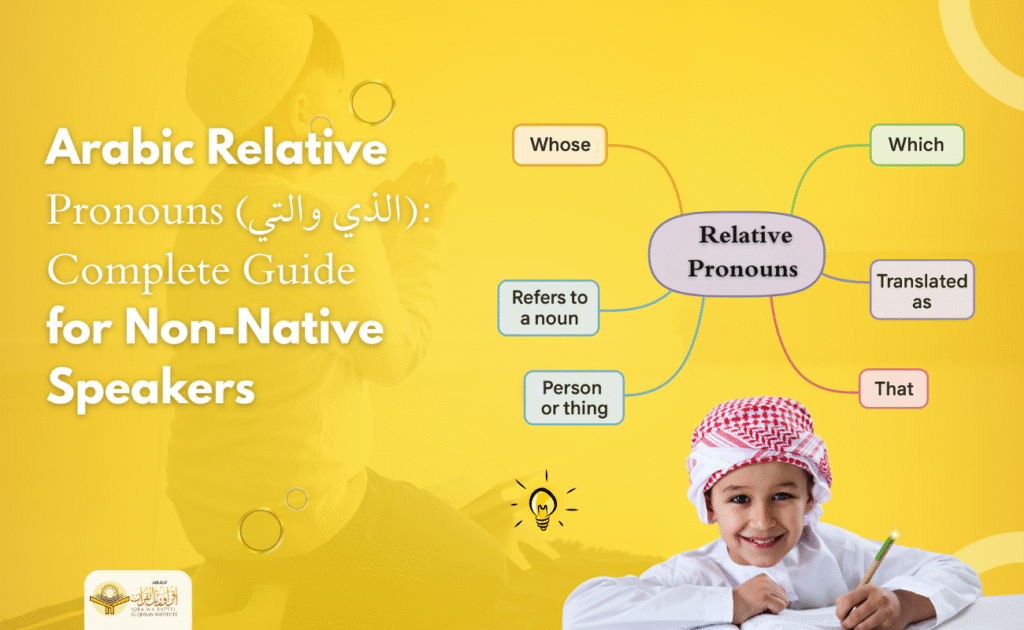
A relative pronoun (اسم موصول – ism mawsool) is a word that:
- Connects a clause to a noun
- Provides additional information about that noun
- Specifies exactly which person or thing you’re talking about
In English, we use words like “who,” “which,” “that,” and “whose.” Arabic has its own set of relative pronouns, and the two most important ones are:
- الذي (alladhee) – for masculine singular
- التي (allatee) – for feminine singular
A Quick Example
English: “The man who lives next door is a teacher.”
Arabic: الرجل الذي يسكن بجواري معلم
(ar-rajul alladhee yaskunu bijuaree mu’allim)
See how الذي connects “the man” with the information “lives next door”? That’s the magic of relative pronouns!
Why Relative Pronouns Are Essential for Arabic Learners
Before we dive deep into the grammar, let me tell you why mastering relative pronouns is absolutely crucial for your Arabic journey:
1. They Make You Sound Natural
Without relative pronouns, your Arabic will sound choppy and childlike:
- ❌ Without: “I saw the man. The man was wearing a hat.”
- ✅ With: “I saw the man who was wearing a hat.”
2. They’re Everywhere in Arabic
From the Quran to newspapers, from conversations to formal speeches—relative pronouns appear constantly. You simply cannot avoid them if you want to truly understand Arabic.
3. They Unlock Complex Meanings
Many profound statements in Arabic literature and religious texts rely on relative pronouns to convey layered meanings. Understanding them opens doors to deeper comprehension.
4. They’re Actually Not That Hard!
Despite their intimidating appearance, relative pronouns follow logical, predictable patterns. Once you understand the system, using them becomes second nature.
The Two Foundation Pronouns: الذي and التي
Let’s start with the two most fundamental relative pronouns in Arabic. Think of these as the building blocks—master these, and everything else becomes much easier.
الذي (Alladhee) – The Masculine Singular
Pronunciation: al-la-THEE (with emphasis on the last syllable)
Used for: Masculine, singular nouns (whether human or non-human)
English equivalents: “who” (for people), “which/that” (for things)
Examples:
For people:
- الطالب الذي درس بجد نجح
- at-taalib alladhee darasa bi-jidd najaha
- “The student who studied hard succeeded”
For things:
- الكتاب الذي قرأته مفيد
- al-kitaab alladhee qara’tuhu mufeed
- “The book that I read is useful”
التي (Allatee) – The Feminine Singular
Pronunciation: al-la-TEE
Used for: Feminine, singular nouns (whether human or non-human)
English equivalents: “who” (for people), “which/that” (for things)
Examples:
For people:
- المرأة التي تعمل في المستشفى طبيبة
- al-mar’ah allatee ta’malu fi al-mustashfaa tabeebah
- “The woman who works in the hospital is a doctor”
For things:
- السيارة التي اشتريتها جديدة
- as-sayyaarah allatee ishtaraytuhaa jadeedah
- “The car that I bought is new”
The Key Difference
The ONLY difference between الذي and التي is gender:
- الذي → Masculine
- التي → Feminine
Everything else—the structure, the usage, the rules—remains exactly the same. Simple, right?
Complete List of Arabic Relative Pronouns
Now that you understand the foundation, let’s look at the complete family of Arabic relative pronouns. Don’t let this table intimidate you—we’ll break each one down step by step.
| Arabic | Transliteration | Used For | English |
|---|---|---|---|
| الذي | alladhee | Masculine Singular | who/that/which |
| التي | allatee | Feminine Singular | who/that/which |
| اللذان / اللذين | alladhaani/alladhayni | Masculine Dual | who/that/which (two) |
| اللتان / اللتين | allataani/allatayni | Feminine Dual | who/that/which (two) |
| الذين | alladheena | Masculine Plural | who/that/which (they) |
| اللاتي / اللواتي | allaatee/allawaatee | Feminine Plural | who/that/which (they) |
| مَن | man | People (any gender/number) | who/whoever |
| ما | maa | Things (not people) | what/whatever |
| أي | ayy | People or things | whichever/any |
| ذو | dhoo | Special (with possessive meaning) | he who has |
Important Note: The first six pronouns (الذي through اللاتي) are called specific relative pronouns because they must agree with the noun in gender and number. The last four are common relative pronouns that work more flexibly.
How الذي Works: Deep Dive
Let’s explore الذي in detail with a practical, step-by-step approach.
Basic Structure
Pattern: [Definite Noun] + الذي + [Verb or Sentence]
Example breakdown:
الرجل الذي يعمل في البنك صديقي
Let’s analyze each part:
- الرجل (ar-rajul) = “the man” (definite, masculine noun)
- الذي (alladhee) = “who” (masculine singular relative pronoun)
- يعمل في البنك (ya’malu fi al-bank) = “works in the bank” (the relative clause)
- صديقي (sadeeqee) = “my friend” (the predicate)
Translation: “The man who works in the bank is my friend.”
When to Use الذي
Use الذي whenever you want to add information about a masculine, singular, definite noun:
✅ Correct uses:
الطبيب الذي عالجني ماهر
at-tabeeb alladhee ‘aalajani maahir
“The doctor who treated me is skilled”
الباب الذي فتحته مكسور
al-baab alladhee fatahtuhu maksoor
“The door that I opened is broken”
❌ Common mistakes:
Don’t use الذي with feminine nouns:
- ❌ البنت الذي… (WRONG!)
- ✅ البنت التي… (CORRECT!)
Don’t use الذي with indefinite nouns:
- ❌ رجل الذي… (WRONG! – no ال on رجل)
- ✅ الرجل الذي… (CORRECT!)
الذي in Different Sentence Positions
الذي can appear in various positions:
1. As subject:
- الذي يعمل بجد ينجح
- alladhee ya’malu bi-jidd yanjah
- “He who works hard succeeds”
2. As object:
- رأيت الطالب الذي فاز بالجائزة
- ra’aytu at-taalib alladhee faaza bil-jaa’izah
- “I saw the student who won the prize”
3. After preposition:
- تحدثت مع الرجل الذي يسكن هنا
- tahadathtu ma’a ar-rajul alladhee yaskunu hunaa
- “I spoke with the man who lives here”
How التي Works: Complete Guide
التي follows exactly the same patterns as الذي, but for feminine nouns.
Basic Structure
Pattern: [Definite Feminine Noun] + التي + [Verb or Sentence]
Example:
المدرسة التي تعلمت فيها ممتازة
al-madrasah allatee ta’allamtu feehaa mumtaazah
“The school where I learned is excellent”
Special Note About Non-Human Plurals
Here’s a crucial rule that confuses many learners:
In Arabic, non-human plural nouns are treated as feminine singular!
This means you use التي (not الذين) with plural objects or animals:
✅ Correct:
- الكتب التي قرأتها
- al-kutub allatee qara’tuhaa
- “The books that I read”
❌ Wrong:
- ❌ الكتب الذين قرأتهم (NEVER do this!)
Why? Because “books” (كتب) is a non-human plural, which always takes feminine singular agreement in Arabic.
More examples:
- البيوت التي بنيت (the houses that were built)
- القطط التي رأيتها (the cats that I saw)
- السيارات التي في الشارع (the cars that are in the street)
Dual Forms: اللذان and اللتان
Arabic has a special feature that English lacks: the dual form for exactly two people or things.
اللذان / اللذين (Alladhaani/Alladhayni)
For: Two masculine entities
Case changes:
- Nominative (subject): اللذان (alladhaani)
- Accusative/Genitive (object/after preposition): اللذين (alladhayni)
Examples:
Nominative:
- الطالبان اللذان نجحا مجتهدان
- at-taalibaan alladhaani najahaا mujtahidaan
- “The two students who succeeded are diligent”
Accusative:
- رأيت الرجلين اللذين سافرا
- ra’aytu ar-rajulayn alladhayni saafara
- “I saw the two men who traveled”
اللتان / اللتين (Allataani/Allatayni)
For: Two feminine entities
Case changes:
- Nominative: اللتان (allataani)
- Accusative/Genitive: اللتين (allatayni)
Examples:
Nominative:
- البنتان اللتان زارتا الحديقة سعيدتان
- al-bintaan allataani zaarata al-hadeeqah sa’eedataan
- “The two girls who visited the garden are happy”
Accusative:
- قابلت المرأتين اللتين تعملان هنا
- qabaltu al-mar’atayn allatayni ta’malaan hunaa
- “I met the two women who work here”
Practical Tip: In spoken Arabic, dual forms are becoming less common, with plural forms often used instead. However, understanding them is essential for reading classical texts, news, and formal Arabic.
Plural Forms: الذين and اللاتي
الذين (Alladheena) – Masculine Plural
Used for: Three or more masculine people (humans only!)
Important rule: الذين is ONLY for human masculine plurals, NOT for things or animals.
Examples:
الطلاب الذين درسوا نجحوا
- at-tullaab alladheena darasoo najahoo
- “The students who studied succeeded”
الرجال الذين حضروا الاجتماع مهمون
- ar-rijaal alladheena hadaroo al-ijtimaa’ muhimmoon
- “The men who attended the meeting are important”
اللاتي / اللواتي (Allaatee/Allawaatee) – Feminine Plural
Used for: Three or more feminine people (humans only!)
Note: Both forms (اللاتي and اللواتي) are correct and interchangeable.
Examples:
النساء اللاتي عملن في المشروع ماهرات
- an-nisaa’ allaatee ‘amilna fi al-mashru’ maahiraat
- “The women who worked on the project are skilled”
الطالبات اللواتي فزن بالمسابقة متفوقات
- at-taalibaat allawaatee fuzna bil-musaabaqah mutafawwiqaat
- “The female students who won the competition are excellent”
Critical Rule Reminder:
- ✅ Use الذين/اللاتي for HUMAN plurals
- ✅ Use التي for NON-HUMAN plurals
Common Relative Pronouns: من and ما
These two pronouns are incredibly useful because they don’t change based on gender or number!
مَن (Man) – For People
Meaning: “who,” “whoever,” “he who,” “those who”
Key feature: Works for any gender and any number—incredibly flexible!
Uses:
1. General statements:
- من يعمل بجد ينجح
- man ya’malu bi-jidd yanjah
- “Whoever works hard succeeds”
2. Questions:
- من الذي فعل هذا؟
- man alladhee fa’ala haadha?
- “Who did this?”
3. After certain words:
- كل من حضر الاجتماع
- kullu man hadara al-ijtimaa’
- “Everyone who attended the meeting”
Quranic Example:
مَن ذَا الَّذِي يُقْرِضُ اللَّهَ قَرْضًا حَسَنًا
Man dha alladhee yuqridu Allaha qardan hasanan
“Who is it that would loan Allah a goodly loan?” (Al-Baqarah 2:245)
ما (Maa) – For Things
Meaning: “what,” “whatever,” “that which,” “the thing that”
Key feature: Used for non-human things, ideas, or abstract concepts
Uses:
1. General statements:
- ما تزرع تحصد
- maa tazra’ tahsud
- “Whatever you plant, you harvest”
2. Questions:
- ما الذي حدث؟
- maa alladhee hadatha?
- “What happened?”
3. In sentences:
- قرأت ما كتبته
- qara’tu maa katabtahu
- “I read what you wrote”
Quranic Example:
وَمَا تُقَدِّمُوا لِأَنفُسِكُم مِّنْ خَيْرٍ تَجِدُوهُ عِندَ اللَّهِ
Wa maa tuqaddimoo li-anfusikum min khayrin tajidoohu ‘inda Allaah
“And whatever good you put forward for yourselves, you will find it with Allah” (Al-Baqarah 2:110)
Agreement Rules: The Golden Rules
To use relative pronouns correctly, you MUST follow these agreement rules:
Rule 1: Gender Agreement
The relative pronoun must match the noun’s gender:
- ✅ الرجل الذي… (masculine noun → masculine pronoun)
- ✅ المرأة التي… (feminine noun → feminine pronoun)
- ❌ الرجل التي… (WRONG! Gender mismatch)
Rule 2: Number Agreement
The relative pronoun must match the noun’s number:
- Singular: الذي / التي
- Dual: اللذان / اللتان
- Plural: الذين / اللاتي (for humans)
- Plural: التي (for non-humans)
Rule 3: Definiteness Requirement
Relative pronouns ONLY work with definite nouns (nouns with ال):
- ✅ الطالب الذي… (definite – has ال)
- ❌ طالب الذي… (WRONG! Indefinite – no ال)
Exception: Common pronouns (من، ما) don’t require a definite antecedent.
Rule 4: Non-Human Plural = Feminine Singular
This is THE most important rule for learners:
ALL non-human plurals use feminine singular forms!
- ✅ الكتب التي (books – non-human plural → use التي)
- ✅ الحيوانات التي (animals – non-human plural → use التي)
- ❌ الكتب الذين (NEVER!)
The Relative Clause (صلة الموصول)
Every relative pronoun is followed by a relative clause (silat al-mawsool) that provides the additional information.
Types of Relative Clauses
1. Verbal Relative Clause (most common)
Starts with a verb:
- الطالب الذي يدرس اللغة العربية
- at-taalib alladhee yadrusu al-lughah al-‘arabiyyah
- “The student who studies Arabic”
2. Nominal Relative Clause
Starts with a noun (less common):
- الرجل الذي هو طبيب
- ar-rajul alladhee huwa tabeeb
- “The man who is a doctor”
3. Semi-Clause (شبه جملة)
Starts with a preposition or adverb:
- المريض الذي في المستشفى
- al-mareed alladhee fi al-mustashfaa
- “The patient who is in the hospital”
The Return Pronoun (الضمير العائد)
Critical concept: Most relative clauses contain a pronoun that refers back to the noun. This is called the “return pronoun.”
Example:
- رأيت الكتاب الذي اشتريته
- ra’aytu al-kitaab alladhee ishtaraytuhu
- “I saw the book that I bought it”
The ـه (-hu) at the end of اشتريته refers back to “the book.”
English translation note: In English, we don’t say “the book that I bought it”—we drop the “it.” But in Arabic, this pronoun is often required for grammatical completeness.
Step-by-Step Examples: Building Sentences
Let’s build some sentences together, step by step.
Example 1: Simple Masculine Sentence
Goal: “The teacher who taught me is Egyptian”
Step 1: Identify the main noun
- “The teacher” = المعلم (al-mu’allim) – masculine, singular, definite ✓
Step 2: Choose the correct relative pronoun
- Masculine singular → الذي (alladhee)
Step 3: Add the relative clause
- “taught me” = علمني (‘allamanee)
Step 4: Add the predicate
- “is Egyptian” = مصري (misree)
Final sentence:
المعلم الذي علمني مصري
al-mu’allim alladhee ‘allamanee misree
Example 2: Feminine Sentence
Goal: “The car that my father bought is expensive”
Step 1: Main noun
- “The car” = السيارة (as-sayyaarah) – feminine, singular, definite ✓
Step 2: Relative pronoun
- Feminine singular → التي (allatee)
Step 3: Relative clause
- “my father bought” = اشتراها أبي (ishtaraahaa abee)
- Note the return pronoun: ـها (-haa) = “it” (feminine)
Step 4: Predicate
- “is expensive” = غالية (ghaaliyah)
Final sentence:
السيارة التي اشتراها أبي غالية
as-sayyaarah allatee ishtaraahaa abee ghaaliyah
Example 3: Plural Non-Human
Goal: “The books that are on the shelf are useful”
Step 1: Main noun
- “The books” = الكتب (al-kutub) – NON-HUMAN plural → treat as feminine singular!
Step 2: Relative pronoun
- Non-human plural → التي (allatee) NOT الذين!
Step 3: Relative clause
- “are on the shelf” = على الرف (‘ala ar-raff)
Step 4: Predicate
- “are useful” = مفيدة (mufeedah) – feminine singular form!
Final sentence:
الكتب التي على الرف مفيدة
al-kutub allatee ‘ala ar-raff mufeedah
Common Mistakes and How to Avoid Them
Let me share the most frequent mistakes I see from students, and how to fix them:
Mistake #1: Using الذين for Non-Humans
❌ WRONG:
- الحيوانات الذين في الحديقة
- al-hayawaanaat alladheena fi al-hadeeqah
✅ CORRECT:
- الحيوانات التي في الحديقة
- al-hayawaanaat allatee fi al-hadeeqah
- “The animals that are in the garden”
Why? Non-human plurals = feminine singular!
Mistake #2: Forgetting the Definite Article (ال)
❌ WRONG:
- رجل الذي رأيته
- rajul alladhee ra’aytuhu
✅ CORRECT:
- الرجل الذي رأيته
- ar-rajul alladhee ra’aytuhu
- “The man whom I saw”
Why? Relative pronouns require definite nouns!
Mistake #3: Gender Mismatch
❌ WRONG:
- البنت الذي ذهبت
- al-bint alladhee dhahabat
✅ CORRECT:
- البنت التي ذهبت
- al-bint allatee dhahabat
- “The girl who went”
Why? البنت is feminine, so use التي!
Mistake #4: Using الذي/التي Instead of من/ما
❌ AWKWARD:
- الشخص الذي يعمل بجد ينجح
- ash-shakhs alladhee ya’malu bi-jidd yanjah
✅ BETTER:
- من يعمل بجد ينجح
- man ya’malu bi-jidd yanjah
- “Whoever works hard succeeds”
Why? For general statements without a specific noun, من is more natural!
Mistake #5: Missing the Return Pronoun
❌ INCOMPLETE (in formal Arabic):
- الكتاب الذي قرأت جيد
- al-kitaab alladhee qara’tu jayyid
✅ COMPLETE:
- الكتاب الذي قرأته جيد
- al-kitaab alladhee qara’tuhu jayyid
- “The book that I read (it) is good”
Why? The pronoun ـه (-hu) connects back to “the book.”
Practice Exercises
Now it’s your turn! Try these exercises to test your understanding.
Exercise 1: Choose the Correct Pronoun
Fill in the blanks with الذي or التي:
- الطالب _____ درس بجد نجح (The student who studied hard succeeded)
- المدرسة _____ زرتها جميلة (The school that I visited is beautiful)
- الباب _____ فتحته مكسور (The door that I opened is broken)
- الكتب _____ قرأتها مفيدة (The books that I read are useful)
- القلم _____ على الطاولة جديد (The pen that is on the table is new)
Answers:
- الذي (masculine singular)
- التي (feminine singular)
- الذي (masculine singular)
- التي (non-human plural → feminine singular!)
- الذي (masculine singular)
Exercise 2: Build Complete Sentences
Translate these sentences into Arabic:
- “The man who works here is my friend”
- “The woman who teaches Arabic is excellent”
- “The cats that I saw are beautiful”
Answers:
الرجل الذي يعمل هنا صديقي
- ar-rajul alladhee ya’malu hunaa sadeeqee
المرأة التي تعلم العربية ممتازة
- al-mar’ah allatee tu’allimu al-‘arabiyyah mumtaazah
القطط التي رأيتها جميلة
- al-qitat allatee ra’aytuhaa jameelah
- (Note: التي because non-human plural!)
Exercise 3: Spot the Mistakes
Identify and correct the errors:
- البنت الذي ذهبت إلى المدرسة (The girl who went to school)
- كتب الذين على الطاولة (Books that are on the table)
- رجل الذي رأيته أمس (Man whom I saw yesterday)
Corrections:
- البنت التي ذهبت إلى المدرسة (الذي → التي, because البنت is feminine)
- الكتب التي على الطاولة (needs ال on كتب, and التي not الذين for non-humans)
- الرجل الذي رأيته أمس (needs ال on رجل)
Real-Life Applications
Understanding relative pronouns opens many doors. Here’s where you’ll encounter them:
1. Reading Arabic News
Headlines and articles constantly use relative pronouns:
- الرئيس الذي زار المدينة (the president who visited the city)
- القضية التي نوقشت (the issue that was discussed)
2. Understanding the Quran
The Quran is full of relative pronouns conveying profound meanings:
- الَّذِينَ آمَنُوا (those who believed)
- مَا أَنزَلْنَا (what We revealed)
3. Daily Conversations
Natural Arabic conversations flow with relative pronouns:
- الفيلم الذي شاهدناه (the movie that we watched)
- المطعم الذي أكلنا فيه (the restaurant where we ate)
4. Academic Writing
Formal Arabic writing relies heavily on complex sentences with relative pronouns:
- الدراسة التي أجراها الباحثون (the study that the researchers conducted)
Advanced Tips for Mastery
Want to take your skills to the next level? Here are some advanced strategies:
Tip 1: Read Aloud Daily
Practice reading Arabic texts containing relative pronouns out loud. This builds muscle memory and makes the patterns automatic.
Tip 2: Create Your Own Examples
Don’t just memorize examples—create your own! Describe people and things around you using relative pronouns:
- “The phone that is on my desk is new”
- “The person who helped me was kind”
Tip 3: Watch Arabic Media
Listen for relative pronouns in Arabic movies, news broadcasts, and YouTube videos. Notice how native speakers use them naturally.
Tip 4: Study Quranic Verses
The Quran is a treasure trove of perfect Arabic. Find verses with relative pronouns and analyze their structure:
Example: وَالَّذِينَ آمَنُوا وَعَمِلُوا الصَّالِحَاتِ
Wa-lladheena aamanoo wa ‘amiloo as-saalihaati
“And those who believed and did righteous deeds” (Al-Baqarah 2:82)
Tip 5: Use Flashcards
Create flashcards with:
- Front: Arabic sentence with relative pronoun
- Back: English translation + grammatical breakdown
Tip 6: Join Language Exchange
Practice with native Arabic speakers who can correct your usage in real-time and provide natural examples.
Tip 7: Keep a Grammar Journal
Whenever you encounter a relative pronoun in your reading, write it down in a journal with:
- The full sentence
- Translation
- Why that particular pronoun was used
Your Learning Journey: Next Steps
Congratulations! You’ve completed this comprehensive guide to Arabic relative pronouns. But learning doesn’t stop here.
Immediate Actions:
- Review this guide at least three times
- Complete all practice exercises until you get them right every time
- Find 10 sentences in Arabic texts with relative pronouns and analyze them
- Create 5 original sentences using الذي and التي
Short-Term Goals (1-2 weeks):
- Master الذي and التي completely
- Understand the non-human plural rule instinctively
- Start using relative pronouns in your Arabic conversations
Medium-Term Goals (1-2 months):
- Learn dual and plural forms
- Practice with native speakers
- Read Arabic articles focusing on relative pronouns
Long-Term Goals (3-6 months):
- Use all forms naturally in speech and writing
- Understand complex Quranic structures
- Help other learners master this topic
Resources for Continued Learning
To truly master Arabic relative pronouns, consider these resources:
Online Courses
- IQRA WA RATTEL – Native Arabic teachers with structured curriculum
- Bayyinah TV – Quranic Arabic with focus on grammar
- ArabicPod101 – Practical lessons with examples
Books
- “Arabic Grammar in Context” by Mohammad T. Alhawary
- “A Reference Grammar of Modern Standard Arabic” by Karin C. Ryding
- “Mastering Arabic” by Jane Wightwick and Mahmoud Gaafar
Apps
- Memrise – For vocabulary and pattern recognition
- Anki – For spaced repetition flashcards
- HelloTalk – For practice with native speakers
YouTube Channels
- Learn Arabic with Maha
- ArabicPod101
- Ustadh Nouman Ali Khan (for Quranic Arabic)
Conclusion: You’ve Got This!
Learning Arabic relative pronouns might seem challenging at first, but with consistent practice and the right approach, it becomes second nature. Remember:
The Key Principles:
- الذي = masculine singular
- التي = feminine singular (AND non-human plurals!)
- Agreement is crucial: gender, number, definiteness
- Practice makes perfect
Think of relative pronouns as the glue that holds complex Arabic sentences together. Once you master them, your Arabic will sound more natural, more sophisticated, and more authentic.
Don’t be discouraged by mistakes—they’re part of the learning process. Even native Arabic speakers sometimes pause to think about the correct form!
Your Challenge
I challenge you to use at least three relative pronouns in your Arabic conversations or writing this week. Start simple, then gradually increase complexity.
Final Encouragement
You’ve taken a huge step by reading this comprehensive guide. The fact that you’ve made it this far shows your commitment to truly understanding Arabic, not just memorizing phrases.
Keep this guide handy, refer back to it often, and remember: every expert was once a beginner who refused to give up.
May your Arabic journey be filled with success, understanding, and beautiful moments of linguistic breakthrough!
مع السلامة وحظاً سعيداً!
(Ma’a as-salaamah wa hadhan sa’eedan!)
Goodbye and good luck!